
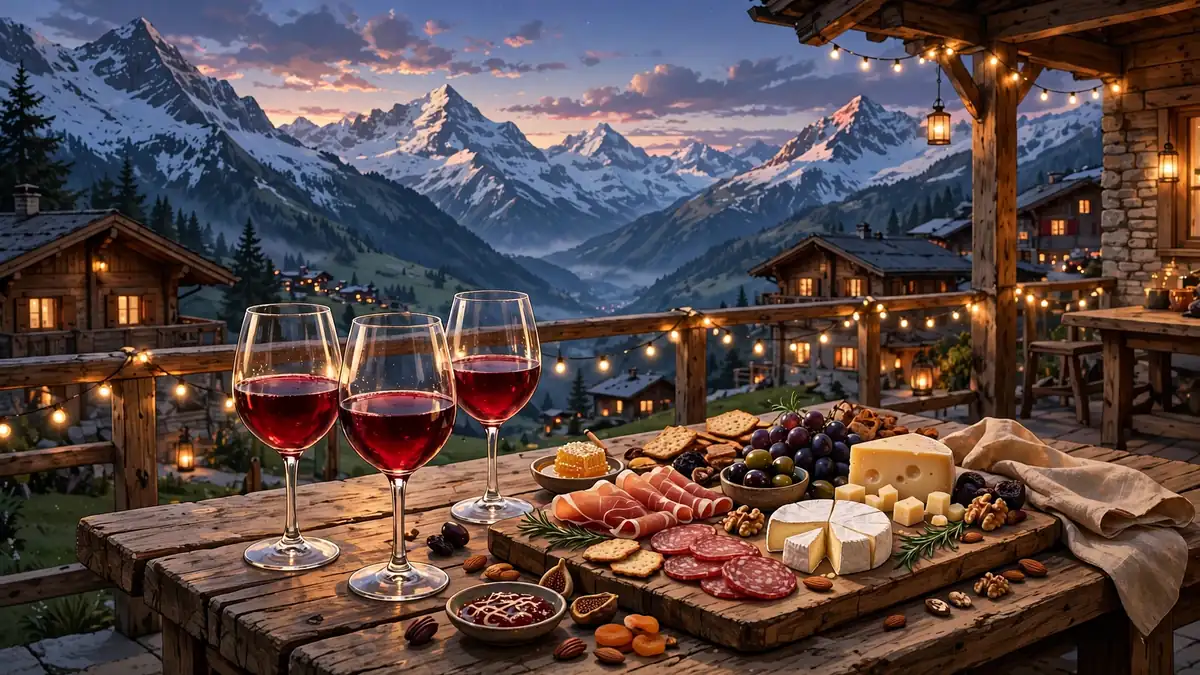
Evening settles over Villeneuve, and the boards arrive at the bar.
Charcuterie and cheese fill the table, and the question follows the food: which red?
Three bottles on the 2014 carte answer it, and each one suits a different evening.
Alcohol abuse is dangerous for your health. Drink in moderation.
Choosing a Red Wine in Short
- Eleven French wine regions fill the 2014 carte, with named producers and no prices.
- Syrah at 100% suits the charcuterie board best.
- Merlot-led and softer, the grand cru suits a special evening and roast meat.
- Savoie’s own red grape suits the local taste: game, meat in sauce, aged mountain cheese.
- Name the producer on the carte when ordering, and ask the counter what is pouring today.
The Three Reds on the Carte
Eleven regions fill the carte’s red list, and three bottles do the evening’s work.
From the northern Rhône it comes, made by Vidal Fleury (1420 carte, 2014).
Bordeaux supplies it, made by Château Carteau (1420 carte, 2014).
Savoie supplies it, made by Terre de Famille (1420 carte, 2014).
| Wine | Grape | Producer on the carte | Best with |
|---|---|---|---|
| Crozes-Hermitage | Syrah, 100% | Vidal Fleury | Charcuterie, game, cheese |
| Saint-Émilion Grand Cru | Merlot-led | Château Carteau | Roast meat, braised beef |
| Mondeuse | Mondeuse | Terre de Famille | Game, meat in sauce, aged cheese |
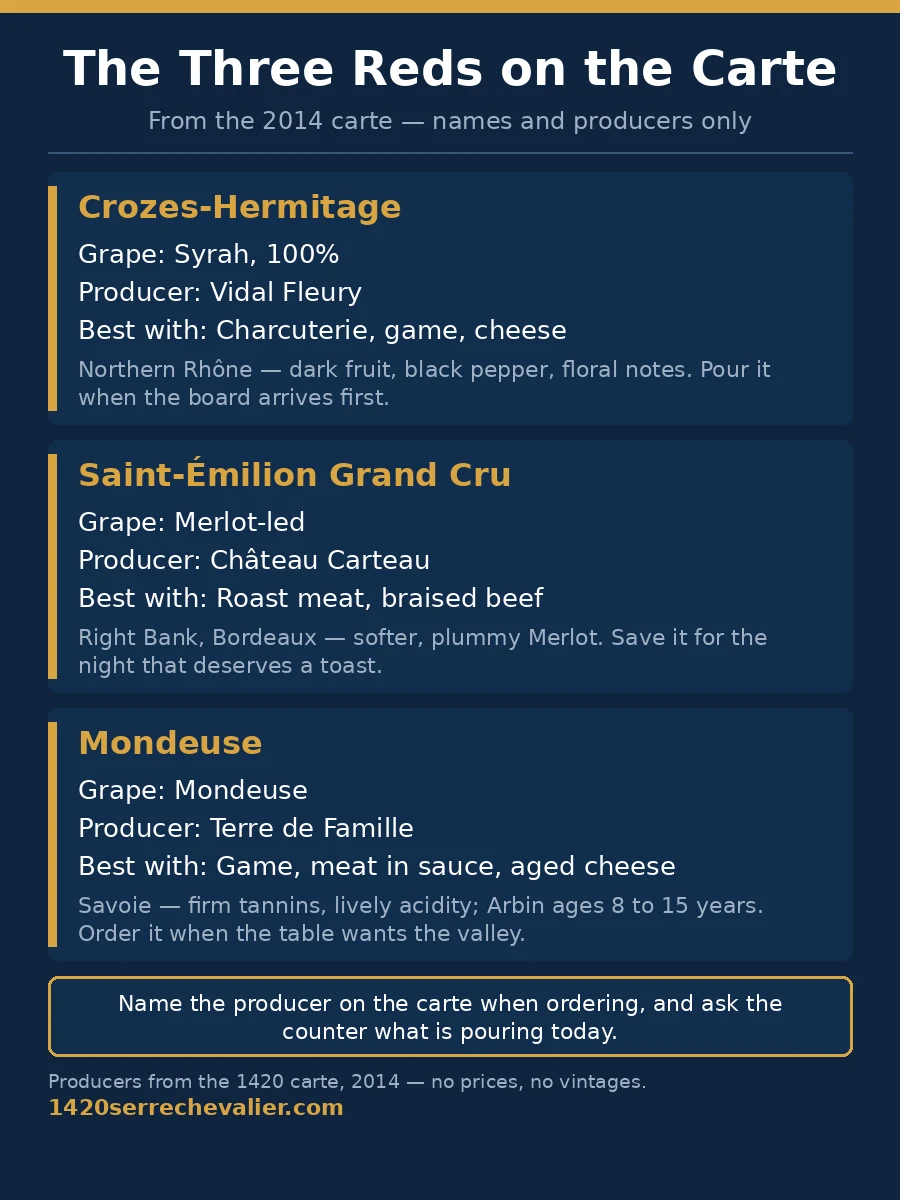
Each of the three reds carries its grape, producer, and best pairing. Pairings run from charcuterie to roast meat and aged cheese.
Names and producers only, no prices, no vintages: that is what the archived capture shows (1420 carte, 2014).
Check with the counter for both, because the bottle in the glass may differ from the name on the page.
Crozes-Hermitage for the Charcuterie Board
Syrah does the work here, and the grape is the whole story.
Crozes-Hermitage is a northern Rhône appellation, and its reds are Syrah-based (TasteAtlas, 2026).
One producer’s sheet names it plainly: 100% Syrah (nRm Millésimes, 2026).
Dark fruit and black pepper mark the glass, with floral notes underneath (Norfolk Wine & Spirits, 2026).
Charcuterie is its natural partner: the wine’s fresh, silky tannins suit cured meat (nRm Millésimes, 2026).
Grilled lamb, herb-roasted beef, steak au poivre, and roasted duck all sit well beside it (Norfolk Wine & Spirits, 2026).
Aged cheeses join the table too, and the pepper in the wine wakes them up.
Red Crozes-Hermitage wines are usually enjoyed young, and they pair with roasted poultry, pork, lamb, or stews (TasteAtlas, 2026).
Pour it when the board arrives first and the evening is still casual.
Saint-Émilion for the Special Evening
Bordeaux answers when the evening turns special, and Saint-Émilion leads it.
Saint-Émilion is a Right Bank Bordeaux, Merlot-led with Cabernet Franc beside it (Drinks House 247, 2026).
Merlot runs softer and plummy, and that softness suits beef cooked medium (Drinks House 247, 2026).
Braised beef is its other home: softer tannins blend with slow-cooked flavour (Carlevana, 2026).
Save it for the night that deserves a toast, not the night that just needs a glass.
Grand Cru on the label marks the estate’s rank, and Château Carteau carries it on the carte.
A special evening earns the grand cru, and an ordinary one wastes it.
Mondeuse for the Local Taste
Savoie grows its own red, and the bar’s nearest neighbour makes it.
Mondeuse is an ancient red grape from France’s Savoie region, prized for deep colour, lively acidity, and firm tannins (Firstleaf, 2026).
Its firm tannins and freshness pair with duck, lamb, pork, beef stews, and a charcuterie board (Firstleaf, 2026).
Aged cheeses suit it too: Tomme de Savoie, Cantal, and Parmesan complement its structure and spice (Firstleaf, 2026).
Meat in sauce is its boldest partner, and raclette and tartiflette its homeliest (Chignin, 2026).
Arbin Mondeuse, from the top estates, can age 8 to 15 years (Avenue des Vins, 2026).
Terre de Famille’s Mondeuse sits a short drive from the bar, and Savoie borders the Hautes-Alpes to the north.
Order it when the table wants the valley in the glass, not a region from far away.
What to Skip, and When
Not every red suits every board, and the carte’s other rows prove it.
Beaujolais stays light: Brouilly and Fleurie suit poultry and lighter fare, not a heavy board (TasteAtlas, 2026).
Loire reds stay bright too, and Chinon and Saumur Champigny suit a different table.
Foreign bottles close the carte, and Lacryma Christi, Banrock Station, and Rioja Crianza change the scene entirely (1420 carte, 2014).
Start the evening with Champagne, before the boards arrive, not beside them.
Ten bottles of Champagne wait on the old shelf, and the table should toast with them first.
Ordering at the Bar
Ordering by name, not by colour, earns the bar’s reward.
Name the producer from the carte, and the counter knows the bottle.
Seasons change the list, so find out what is pouring today.
Ask for the vintage too, because the 2014 carte lists none.
A glass first, a bottle second: taste before committing to the evening’s pour.
Water sits on the table too, and altitude dries the mouth faster than the valley floor.
How the bar pours, and what the boards hold, the wine guide tells in full: Wine in Serre Chevalier.
For the bottle before ordering, read the label guide: How to Read a French Wine Label Before You Order It.
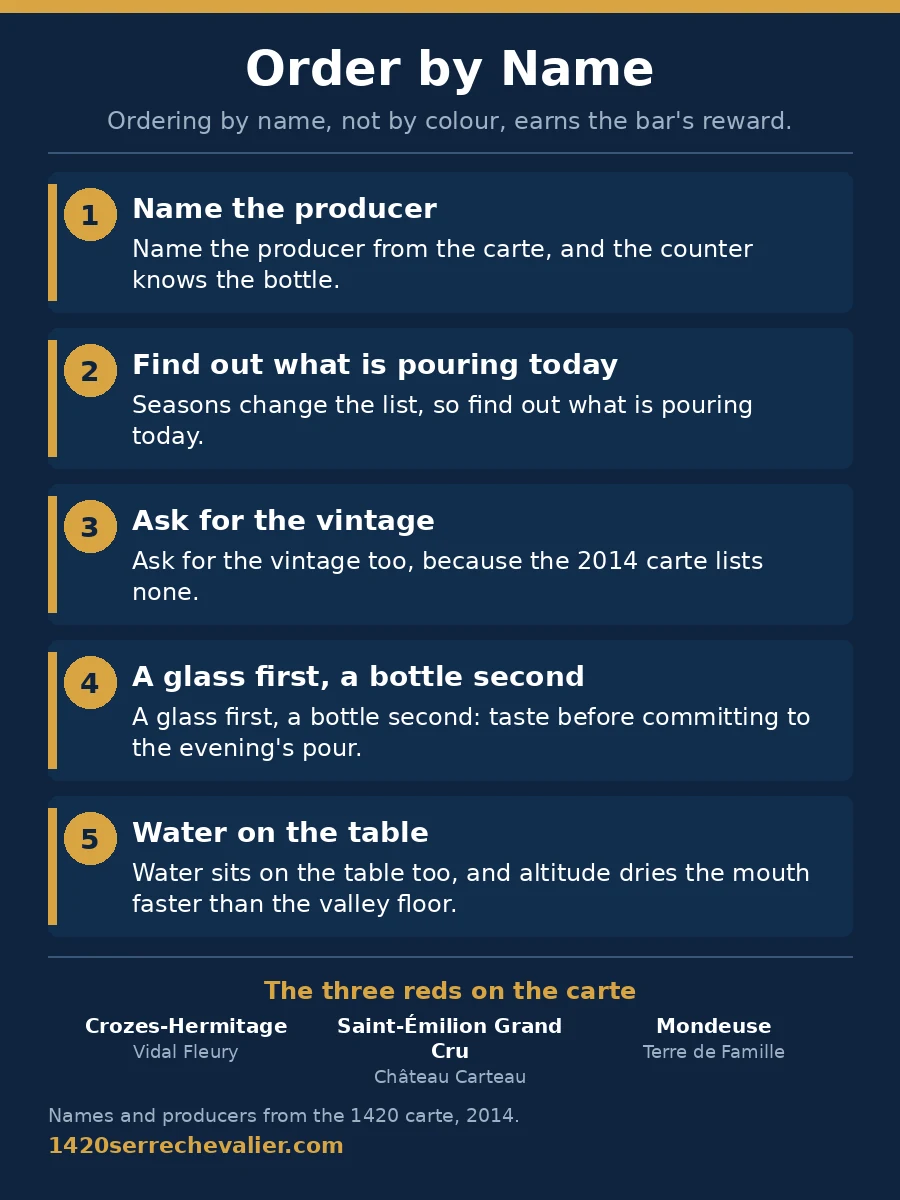
Order by name, not by colour, and the counter knows the bottle. Five steps take you from the carte to the first glass.
Frequently Asked Questions
Which red wine suits a charcuterie board?
Crozes-Hermitage, a 100% Syrah: its fresh, silky tannins suit cured meat (nRm Millésimes, 2026).
Mondeuse suits the board too, with its firm tannins and lively acidity (Firstleaf, 2026).
Which red suits a special evening?
Saint-Émilion Grand Cru, Merlot-led and softer, suits roast meat and a toast (Drinks House 247, 2026).
Save the grand cru for the night that deserves it.
What is Mondeuse?
Savoie’s own red grape, ancient, tannic, and spicy, grown just north of the Hautes-Alpes (Firstleaf, 2026).
Its best partners are game, meat in sauce, and aged mountain cheese.
Does the 2014 carte list prices or vintages?
Only names and producers, says the archived capture (1420 carte, 2014).
Get the price and the vintage from the counter, for the bottle in the glass.
Can I order these wines at Le 1420?
The carte names them, and the bar pours from its own list, which changes with the season.
Check the counter for what is pouring today.
Methodology
Names and producers follow the 1420 carte (2014) as printed; no price or vintage was added.
Pairing guidance comes from producer sheets and wine guides, checked 25 November 2026.
Grape facts come from TasteAtlas, Firstleaf, and producer pages, checked the same day.
This guide recommends no bottle and reports no tasting of its own.
Hand-checked against the sources in References, every fact stands as written.
References
- Crozes-Hermitage 2018 | nRm Millésimes
- 59 Best Wines in Rhône-Alpes | TasteAtlas
- What Red Wine Goes With Roast Beef? | Drinks House 247
- Mondeuse | Firstleaf Wine Guide
- Everything you need to know about Mondeuse de Savoie | Chignin
- Red Wines from Savoie | Avenue des Vins
- Food combinations with red dry wine | Carlevana
- Les Vins de Vienne Crozes-Hermitage 2023 | Norfolk Wine & Spirits