
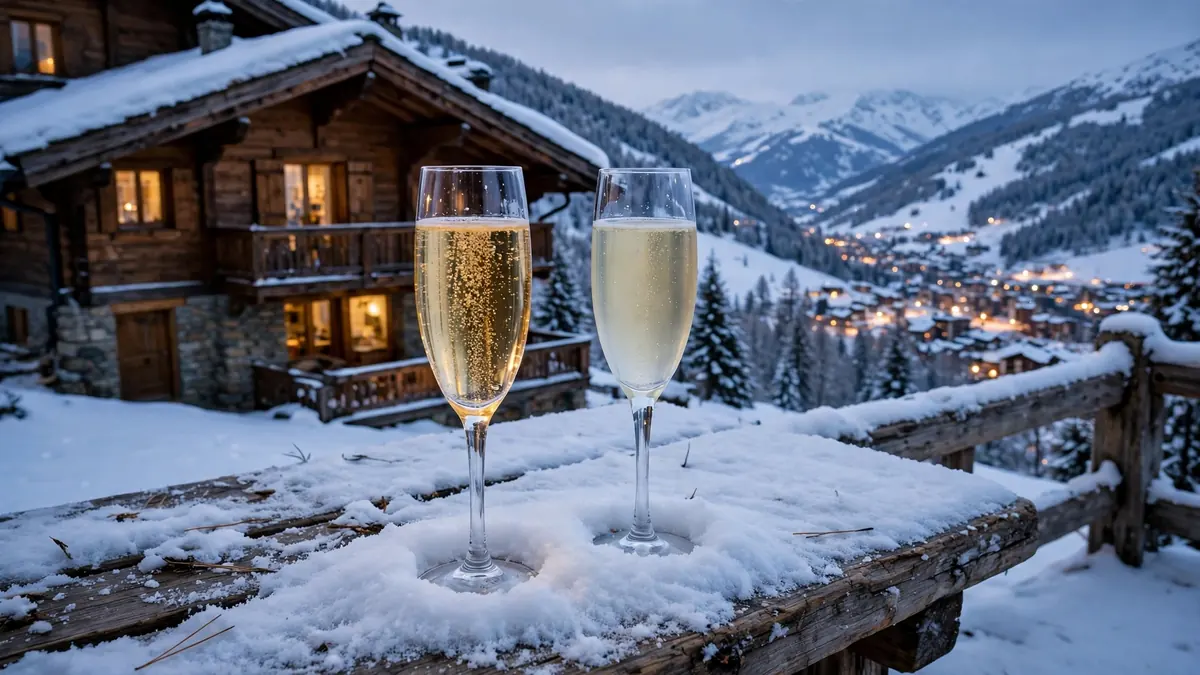
Snow settles on Villeneuve, and the bar fills with skiers who want one champagne toast before dinner.
The old shop once stocked ten champagnes on the old shop shelf, and that count still shapes how this valley celebrates.
Its price comes from one protected region, not from a secret method.
Crémant follows the same bottle method, and it reaches the glass for far less money.
Alcohol abuse is dangerous for your health. Drink in moderation.
Champagne vs Crémant in Short
- One method fills both bottles: second fermentation inside the bottle, with lees ageing after it.
- Eight French appellations carry the crémant name, while champagne comes from one protected region.
- Non-vintage champagne rests at least fifteen months, and crémant rests at least nine months on lees.
- Good crémant costs roughly ten to twenty euros, and non-vintage champagne from a major house costs forty to sixty.
- Champagne suits the toast where the bottle is seen, and crémant suits the table where the food leads.
The One Method Both Bottles Share
Each wine starts still, with modest alcohol and sharp acidity, before the second fermentation.
Yeast and sugar join the bottle at tirage, and the second fermentation starts inside sealed glass.
Trapped gas stays in the wine, and it escapes only when the cork comes out.
Lees ageing follows, and the spent yeast cells lend bread, brioche, and toasted notes over time.
Riddling gathers the sediment in the neck, disgorgement removes it, and dosage sets the final sweetness.
Hand harvesting and whole-bunch pressing apply to both, and neither wine ferments its bubbles in a tank.
That shared method is why the two glasses can look alike, and why the label alone never settles the choice.
Prosecco differs here: its second fermentation runs in a pressurised tank, not in the bottle.
Eight Appellations, Not One Region
Champagne names one region in north-eastern France, around Reims and Épernay, under a single protected AOC.
No sparkling wine from elsewhere may use the name, whatever method its maker followed.
Across eight appellations, the same method spreads under the crémant name, each borrowing the grapes of its home region.
Luxembourg holds one more crémant appellation under its own protected rules.
| Appellation | Grapes at its core |
|---|---|
| Alsace | Pinot Blanc, Riesling, Auxerrois, Pinot Gris, Pinot Noir, Chardonnay |
| Bourgogne | Chardonnay, Pinot Noir, Gamay, Aligoté |
| Loire | Chenin Blanc, Cabernet Franc, Chardonnay |
| Bordeaux | Sémillon, Sauvignon Blanc, Muscadelle, Cabernet Franc |
| Jura | Chardonnay, Pinot Noir, Poulsard, Trousseau |
| Limoux | Mauzac, Chardonnay, Chenin Blanc |
| Die | Clairette |
| Savoie | Jacquère, Altesse, Chasselas, Mondeuse |
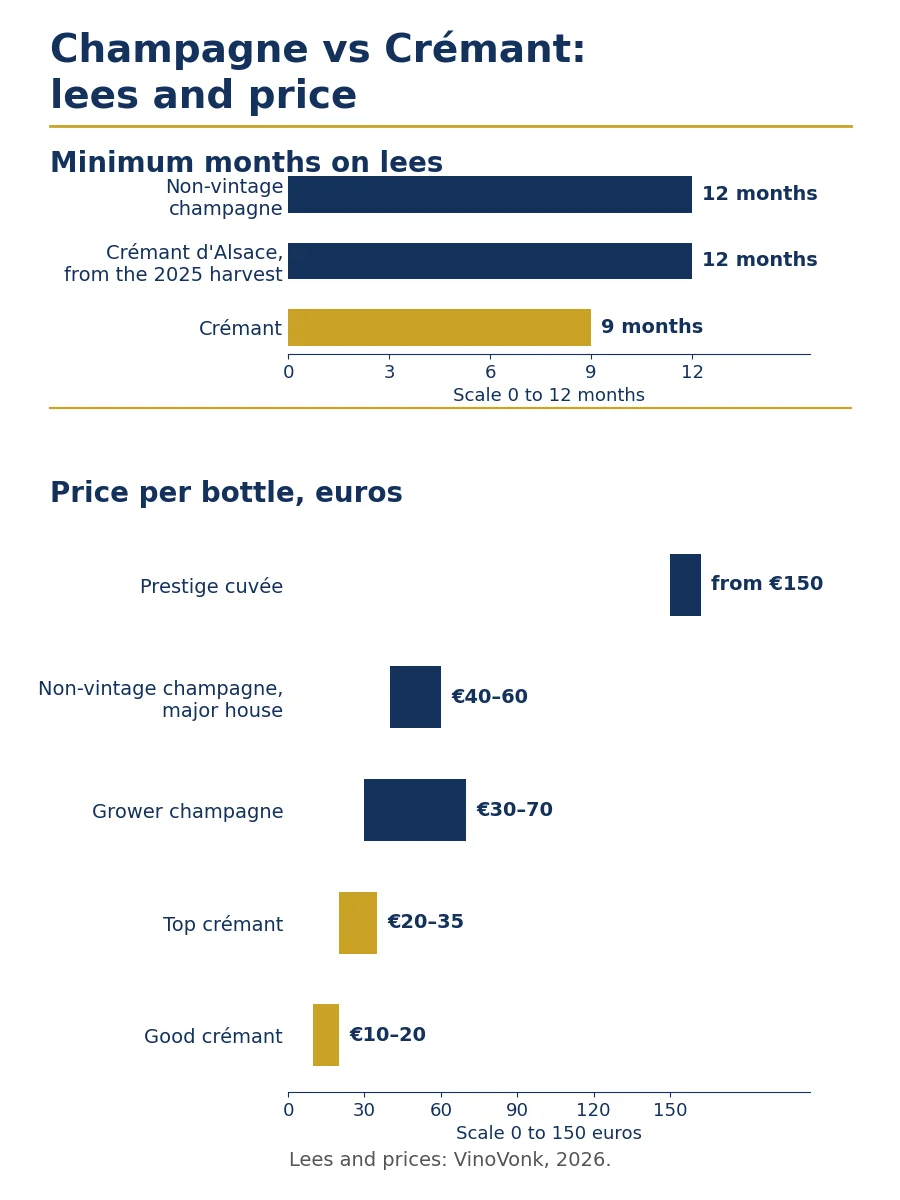
Lees months run nine for crémant, twelve for non-vintage champagne, and twelve for Alsace from 2025. Prices run €10–20 for good crémant and €40–60 for non-vintage champagne from a major house.
Neighbouring regions can pour crémants that share nothing but bubbles, and that range is the point.
Savoie brings the mountain grapes Jacquère and Altesse, the same pair that answers fondue at the table.
Of the eight, the Bourgogne bottle stays closest to champagne, sharing its Chardonnay and Pinot Noir on limestone soils.
Where the Price Gap Comes From
Three things set the gap: land, time, and the name on the label.
Vineyard land inside the Champagne boundary ranks among the costliest farmland in France, and the boundary cannot grow (Seller of Wines, 2026).
Time costs money too: longer ageing ties up stock, cellar space, and capital for years.
Non-vintage champagne must age fifteen months in total, with at least twelve on the lees (VinoVonk, 2026).
Vintage champagne must wait three years, and crémant needs nine months on lees with twelve before release.
Crémant d’Alsace raised its lees minimum to twelve months from the 2025 harvest (VinoVonk, 2026).
Prestige cuvées start near 150 euros, while serious crémant tops out near twenty to thirty-five (VinoVonk, 2026).
A grower champagne often sits between thirty and seventy euros, between the houses and the crémants.
Bourgogne producers now age some cuvées twenty-four or thirty-six months, closing the gap from below (Glass of Bubbly, 2026).
In 2024 the Comité Champagne reported around 271 million bottles shipped, a scale no crémant region approaches (Seller of Wines, 2026).
What Each Bottle Tastes Like
Chalk soils and a cool climate shape the glass, with citrus, green apple, and fine bubbles.
Longer lees contact adds brioche, toast, and roasted nuts, the flavours time builds in the cellar.
Alsace leans floral and crisp, with white flowers and orchard fruit in the glass.
Its Bourgogne glass runs rounder, with lemon curd and hazelnut, sometimes rivalling a Blanc de Blancs.
Loire leads with Chenin Blanc, and its honey, quince, and chalk mark a character champagne cannot copy.
Savoie carries Alpine grapes, and its freshness suits mountain food better than any prestige label.
Blind tastings often confuse a good crémant with an entry-level brut champagne, and a great champagne confuses with nothing.
Serve both well chilled, but never ice cold, because cold flattens the aromas in either glass.
When Champagne Earns It, and When Crémant Wins
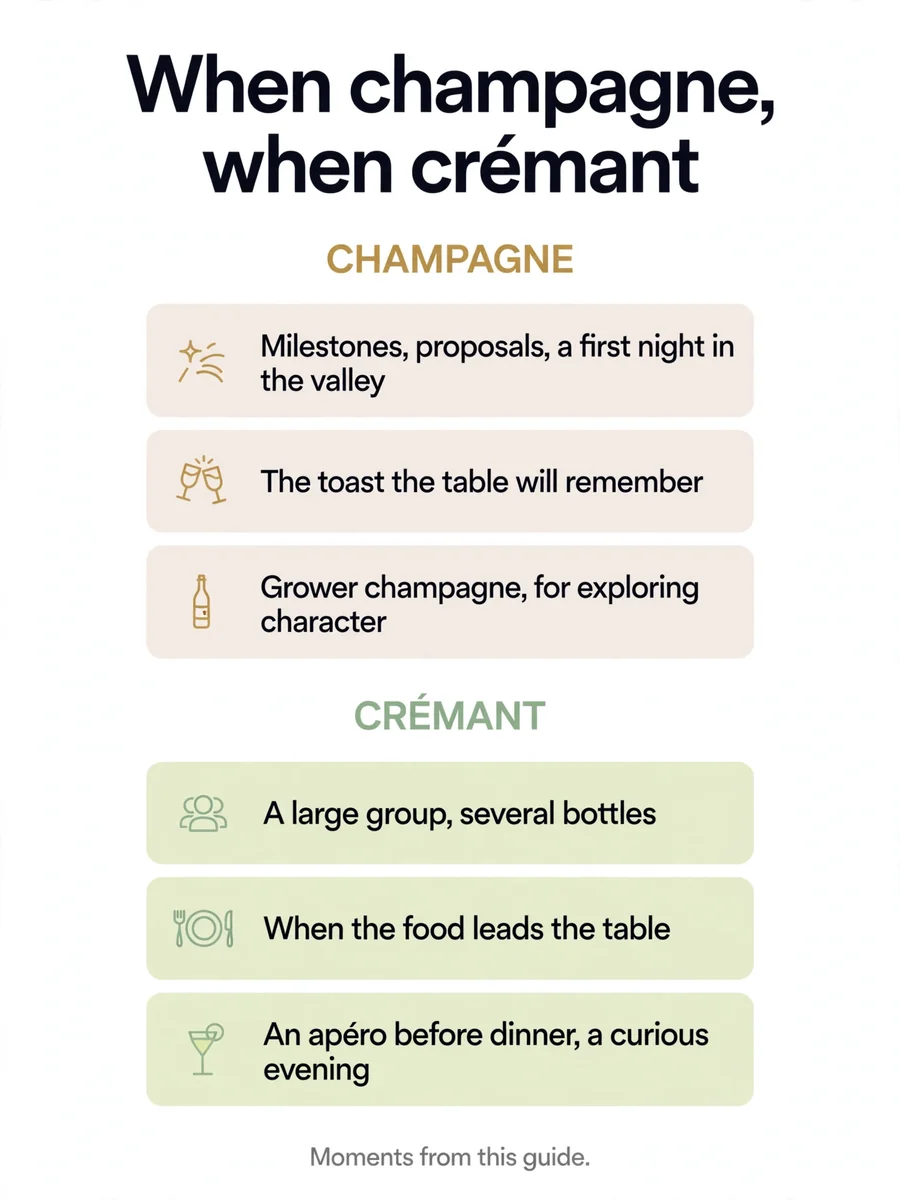
Milestones, proposals, and a first night in the valley take champagne, while long evenings take crémant. Three moments each, chosen by the occasion, not by the label.
Choose champagne when the bottle itself is the event, and the table will look at it before tasting it.
Milestones, proposals, or a first night in the valley all give the name its proper stage.
Grower champagne suits a second kind of evening, one spent exploring character over consistency.
Choose crémant when the group is large, the food leads, or the budget must stretch across several bottles.
An apéro before dinner, a table of skiers, or a curious evening with Chenin Blanc all favour crémant.
For a mountain table, Crémant de Savoie pairs the local grapes with the local food, and the price leaves room for a second bottle.
Ordering at Le 1420
Check with the counter for the bottle in the glass, since the list follows the season.
Name the appellation, not just the word crémant, since each one pours a different wine.
A Bourgogne crémant comes closest to champagne, and a Savoie crémant stays closest to the valley.
Start the evening with bubbles before the boards arrive, and let the reds follow the food.
The full story of the bar, its cellar, and its table sits in the valley guide: Wine in Serre Chevalier.
For the evening itself, the après-ski guide sets out five steps at the bar: Après-Ski in Serre Chevalier.
Frequently Asked Questions
Is crémant made the same way as champagne?
Yes, both use the méthode traditionnelle, with second fermentation in the bottle, but ageing differs: nine months on lees for crémant, twelve for non-vintage champagne.
How big is the price gap?
Good crémant costs ten to twenty euros, and top examples reach twenty to thirty-five (VinoVonk, 2026).
From a major house, a non-vintage bottle runs forty to sixty euros, and prestige cuvées start near 150.
Which crémant is closest to champagne?
Bourgogne, sharing champagne’s Chardonnay and Pinot Noir on limestone soils (Glass of Bubbly, 2026).
Producers who age beyond the nine-month minimum close the gap further.
Can crémant age?
Most crémant drinks best young, within two to three years of disgorgement (Wine with Seth, 2026).
Extended-ageing cuvées from Alsace and Bourgogne develop real complexity over five years or more.
What should I open at Le 1420?
Open champagne for the toast the table will remember, and crémant for the evening that runs long.
Ask the counter for Crémant de Savoie when the food is Savoyard.
Methodology
Facts on method, ageing, grapes, and prices come from VinoVonk, Glass of Bubbly, Wine with Seth, and Seller of Wines, all read 26 November 2026.
Price ranges are online asking prices from those guides, not a price list from the bar.
Ten champagnes on the old shelf: that count comes from the valley wine guide and its archived catalogue.
This guide tastes nothing and sells nothing: it only compares what the sources describe.
Sources in References back every fact above; nothing here rests on an unchecked claim.