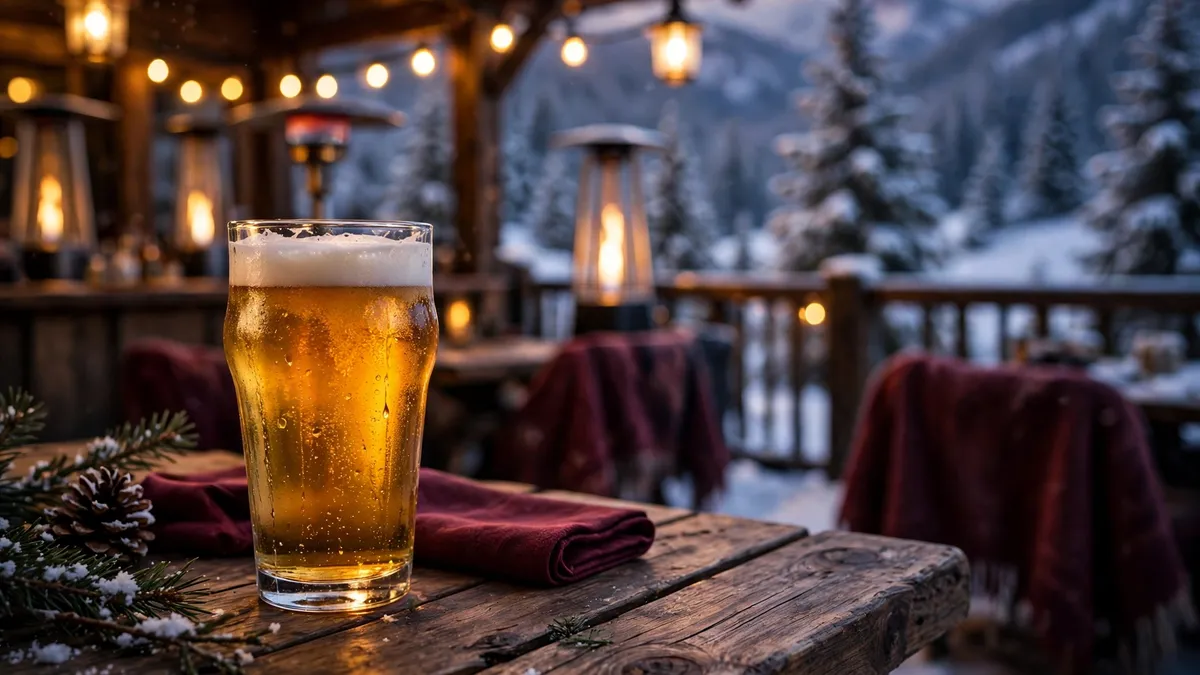
Main image: AI illustration.
After a day on the slopes above Villeneuve, the bar at Le 1420 pours a beer brewed down the valley in Briançon.
That beer is La Tourmente beer, brewed in Briançon and stocked nine varieties deep by the old 1420 shop.
Nine bottles, one brewery, and a valley that drinks its own beer first: that is the whole story.
One brewery, one valley, nine bottles: the range is small, and that smallness is the point.
Alcohol abuse is dangerous for your health. Drink in moderation.
The Range at a Glance
- Blonde: the light pilsner, the first Tourmente most drinkers meet.
- Blanche: the wheat beer, brewed with orange blossom and coriander.
- Génépi: the pale ale infused with the mountain plant of the same name.
- Noël: the winter warmer, brewed for the cold months.
Born in Briançon in 1998
Brasserie des Grands Cols began brewing in Briançon in 1998, in the heart of the Alps (Untappd, 2026).
Its beers carry the name La Tourmente, and the brewery still works from Briançon today.
Three founders created the brewery, and a later triple beer celebrates their twenty-fifth year (Untappd, 2026).
Twenty-five years in, a triple beer marked the anniversary (Untappd, 2026).
Small batches and local ingredients shape the range, not scale: the brewery calls itself a microbrewery (Untappd, 2026).
Grands Cols means great mountain passes, the roads that link the valley’s ski villages.
Untappd counts more than 7,700 check-ins for the brewery (Untappd, 2026).
Nine Beers on the Old Shop Shelf
The 1420 shop stocked nine Tourmente beers, every one in a 33-centilitre bottle (1420 shop catalogue, 2023).
Each bottle cost €3.50 in the catalogue of 2021–2023, a flat price across the whole range (1420 shop catalogue, 2021–2023).
| Beer | Style | Notes |
|---|---|---|
| Blonde | Czech-style pilsner | Light and refreshing, 4.6% alcohol |
| Blanche | Wheat beer | Orange blossom and coriander, 5.1% alcohol |
| Ambrée | Belgian pale ale | Caramel malt and fruity esters, 5.9% alcohol |
| Choucas | Dark beer | The range’s brune, dark by definition |
| Dahu | Amber ale | Second amber ale in the range |
| Génépi | Spiced pale ale | Infused with génépi from the mountains, 5.1% alcohol |
| Grivoise | Red-fruit wheat beer | Red fruits, the range’s fruit beer |
| IPA | Session IPA | Hoppy and light, the range’s IPA |
| Noël | Winter warmer | Winter seasonal, 8% alcohol |
Start with the Blonde if you want the plainest taste of the brewery; try the Génépi if you want the mountain in the glass.
A flat price says something: the brewery priced by the bottle, not by the style (1420 shop catalogue, 2021–2023).
Beer held the smallest shelf in the shop: nine Tourmente against ten gins, seven rums, and three whiskies (1420 shop catalogue, 2023).
Juices and sodas shared the shelf: three juices and two sodas stood beside the beers (1420 shop catalogue, 2023).
Nine Beers, Three Colours
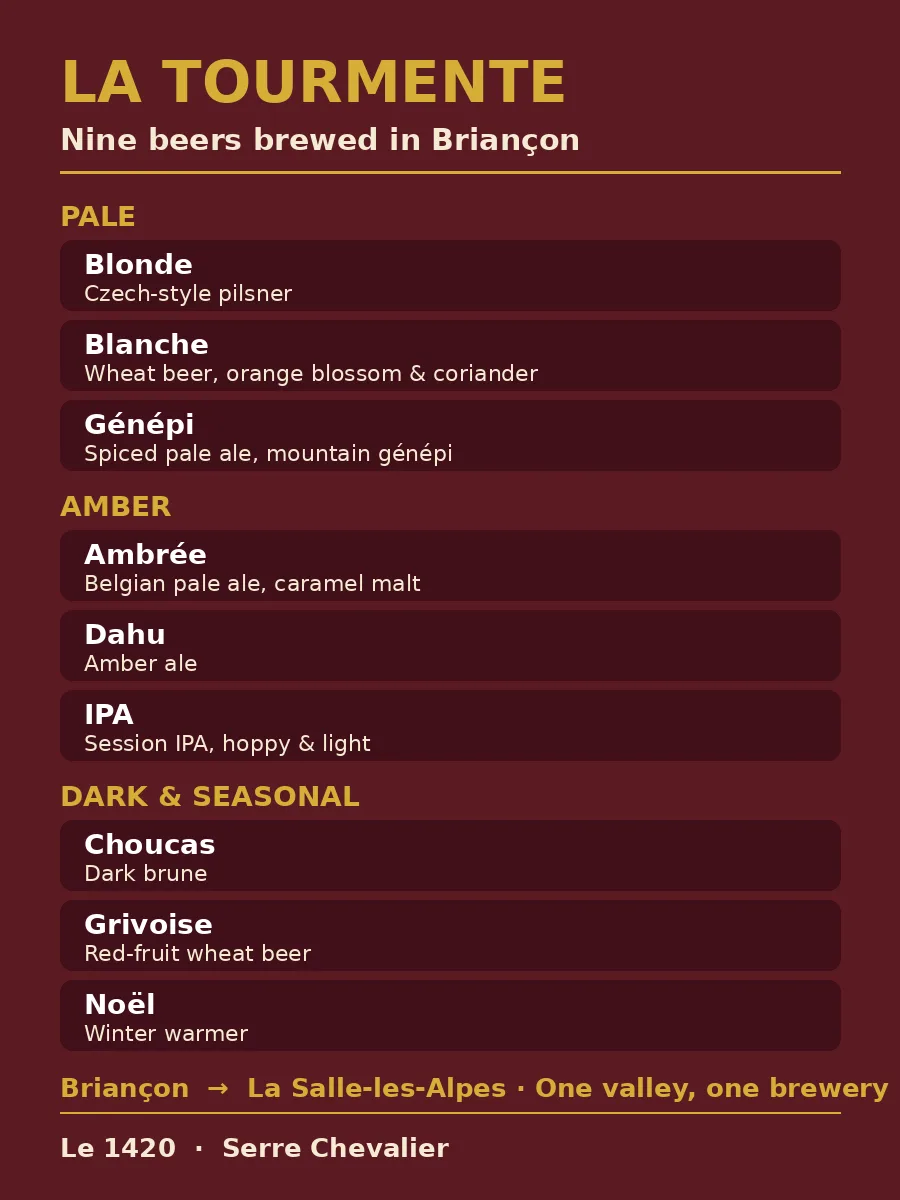
Pale beers lead the range: the Blonde pilsner and the Blanche wheat beer open the list (Untappd, 2026).
Amber holds the middle: Ambrée and Dahu both pour amber, and Génépi adds mountain herbs to a pale base.
Dark, fruit, and seasonal close the list: Choucas the brune, Grivoise the fruit beer, and Noël the winter warmer.
Hoppy and light, the IPA stands apart from the amber core.
Blanche pours pale and cloudy, the wheat beer’s signature look.
Orange blossom and coriander give the Blanche its character, the classic witbier spice pair.
Caramel malt gives the Ambrée its colour and its roundness, the Belgian pale ale’s signature.
Winter warmers brew for the cold months, and Noël arrives when the snow does.
What the Names Mean
Mountain words fill the list: choucas is the alpine chough, a black bird of the high cliffs.
Dahu is the imaginary animal of Alpine jokes, a creature with legs shorter on one side.
Génépi names a plant, not a place: the Artemisia gathered on high slopes for liqueurs and beer.
How Strong, How Bitter
Bitterness stays low across the range: the beers measure 8 to 17 IBU, with Génépi lowest and the session IPA highest (Untappd, 2026).
IBU counts bitterness units: the higher the number, the more bitter the beer.
What “Local” Means at 1,420 Metres
Local here means brewed in the same valley where it is drunk, not trucked in from far away.
Briançon sits down the Guisane valley from La Salle-les-Alpes, and the beer travels that same road.
Some Tourmente beers carry thyme or génépi, plants gathered in these mountains for the brewery’s recipes (Provence-Alpes-Côte d’Azur tourism, 2026).
That is why the range tastes of the place: the flavourings grow where the drinkers ski.
Local also means seasonal: Noël arrives for winter, and the range shifts with the snow.
A beer brewed elsewhere could copy the recipes, but it could not copy the address.
Drinkers in the valley meet the beer where it was brewed, not as an import with a mountain picture.
The Tourism Site’s Tip
Regional tourism puts it plainly: ‘Don’t miss the La Tourmente beers of the Brasserie des Grands Cols’ (Provence-Alpes-Côte d’Azur tourism, 2026).
High-altitude wine shares that article, making three alpine drinks in one place.
From the Shop Shelf to the Bar
The shop sold Tourmente by the bottle; the bar pours it by the glass, draught and bottled both.
Takeaway ran through the same counter: bottles left “à emporter ou en livraison chez-vous”, to take away or delivered at home.
What changed between the shop and the bar is the question, not the beer: bottle or glass, same brewery.
Ask for the Blonde on draught when it is pouring; the bottle list covers the rest.
Draught suits the Blonde best: cold, light, and poured fresh at the counter.
Tourmente was the local core, but the 2014 carte also listed world beers beside it (1420 carte, 2014).
Order by Name, Not by Colour
Order by name, not by colour: nine beers share four colours, and colour alone will not find your bottle.
Blonde means the pilsner; Blanche means the wheat beer; Ambrée means the Belgian pale ale.
Choucas, Dahu, and Noël need their names too: the dark, the second amber, and the winter one.
Colour words do the sorting: blonde, blanche, ambrée, and brune name the beer by its shade.
Après-Ski Runs on Beer
Après-ski runs on beer at Le 1420, and Tourmente is the beer the evenings run on.
Concerts, DJ sets, and sports on screen fill those evenings, and the Blonde keeps up with all of them.
No other beer on the shelf belongs to the valley the way Tourmente does.
Après-ski hours run on beer here, not wine, and the Blonde leads the pour.
The Range Since the Shop Closed
Untappd lists newer Tourmente beers beyond the nine, including a triple and a porter (Untappd, 2026).
Brewing continued after the shop closed, and the range kept growing with it.
New beers keep arriving on Untappd, and the nine on the old shelf are now the brewery’s history.
Beer With the Boards
Home-made sharing boards of charcuterie and cheese sit beside the beers at the bar.
Amber beer and mountain cheese share the same table here, and the bar serves them together.
Boards carry charcuterie and cheese, and the amber beers sit beside them.
Start With the Blonde
Blonde is the honest first bottle: light, local, and brewed to be drunk cold after skiing.
Génépi suits drinkers who want the mountain flavour; it does not suit anyone who dislikes herbal beer.
Save Génépi for the second bottle, after the Blonde has shown the brewery’s lighter hand.
Noël suits a cold evening at the end of a ski day; it does not suit a first tasting at lunch.
For the full valley shelf, the guide to wine in Serre Chevalier sets Tourmente beside the wines, liqueurs, and the bar.
Evenings at the bar run on concerts, DJ sets, and sports on screen — see Après-Ski at Le 1420 Wine Bar.
No range of nine covers every taste, and this one does not try: it covers one valley, brewed where it is drunk.
Start blonde, turn to Génépi, end with Noël: that order carries a drinker through the range.
Briançon brews it, the valley stocks it nine deep, and the bar pours it where it was made.
Frequently Asked Questions
Where is La Tourmente brewed?
In Briançon, in the Hautes-Alpes, by the Brasserie des Grands Cols (Untappd, 2026).
Its full name is Brasserie Artisanale des Grands Cols.
How many Tourmente beers did the old shop stock?
Old shop shelves held nine, all in 33-centilitre bottles at one flat price in the 2021–2023 catalogue (1420 shop catalogue, 2021–2023).
Every bottle held 33 centilitres, and the price never varied by style.
Which Tourmente is the strongest?
Noël, the winter warmer, at 8% alcohol (Untappd, 2026).
Does La Tourmente use local plants?
Yes. Some beers carry thyme or génépi, plants gathered in these mountains (Provence-Alpes-Côte d’Azur tourism, 2026).
Thyme flavours some beers; génépi flavours others.
Can I buy Tourmente outside the valley?
This guide cannot confirm that: the range is documented only on the old 1420 shop shelves.
Methodology
Facts here come from the brewery’s Untappd page, the archived 1420 shop catalogue of 2021–2023, and the regional tourism site, all listed in References.
Prices come only from the archived catalogue and carry their years; no current price appears anywhere.
Beer strengths come from Untappd listings; four varieties carry no strength here because no source states one.
Brewery details come from Untappd’s brewery page, checked on 22 November 2026.
An AI-assisted first draft was checked by hand against every source in References.