
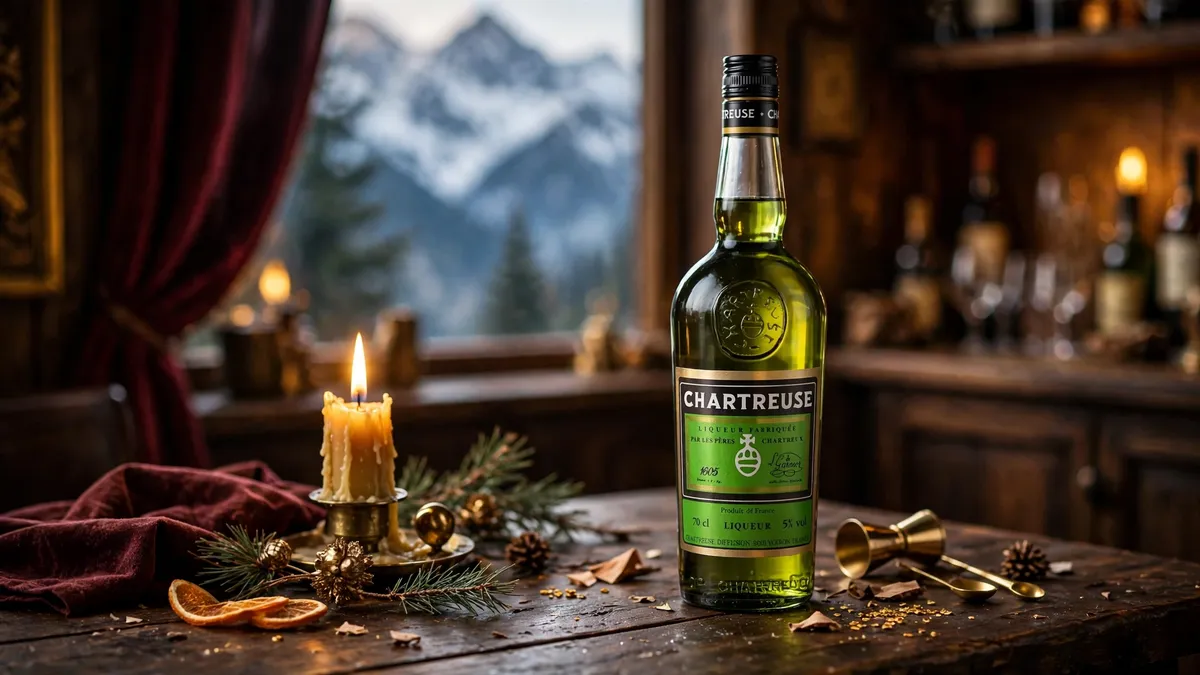
Main image: AI illustration.
Anyone reaching for a Chartreuse liqueur guide usually starts with one question: green or yellow?
Behind that question sits four hundred years of monks, mountains, and one recipe nobody outside the order has ever seen.
Le 1420 keeps ten bottles of it on the shelf, spanning four expressions that taste nothing alike.
Alcohol abuse is dangerous for your health. Drink in moderation.
Chartreuse in Short
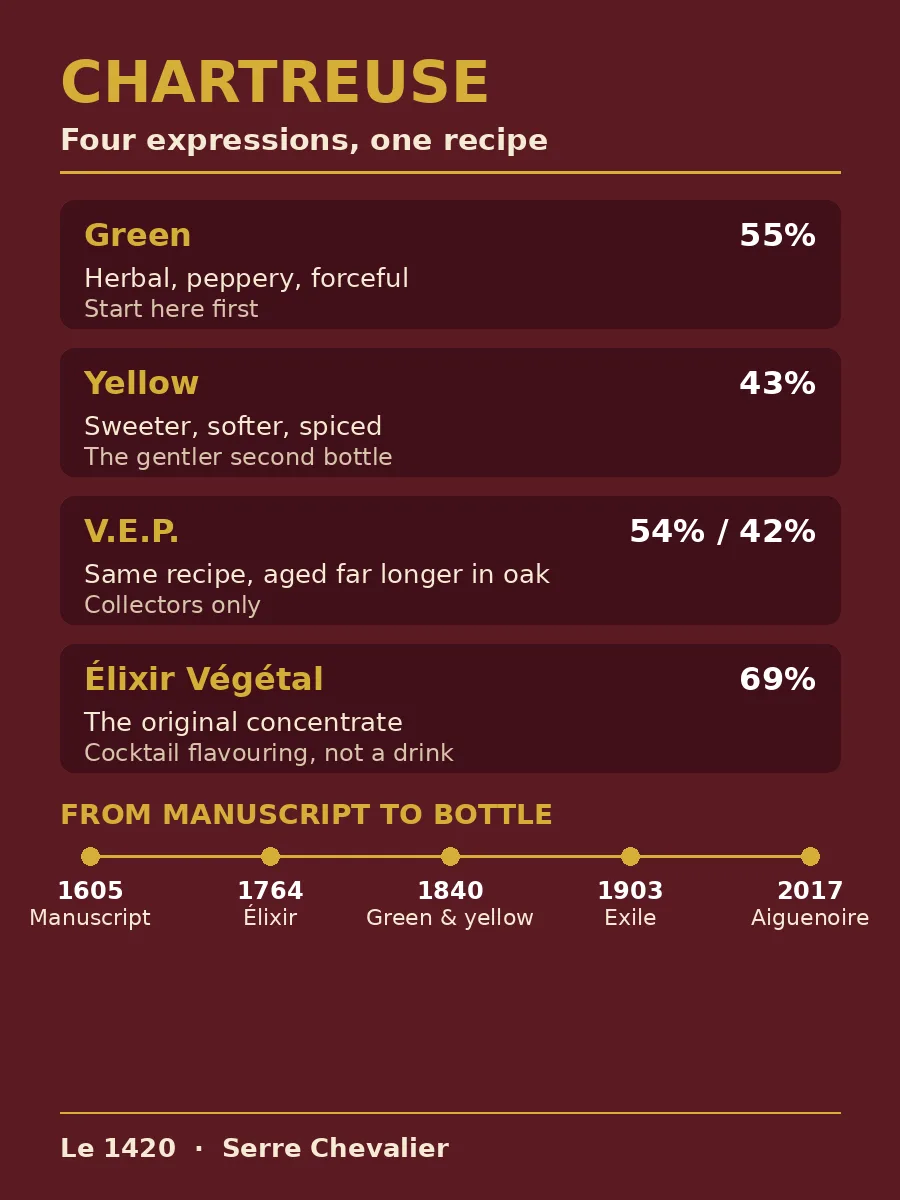
- Green Chartreuse: herbal and forceful, the one most drinkers meet first.
- Yellow Chartreuse: sweeter and softer, built from the same plants.
- V.E.P.: the same two liqueurs aged far longer in oak, bottled for collectors.
- Élixir Végétal: the original recipe, a concentrate rather than a drink.
Four Centuries in One Manuscript
Saint Bruno founded the Carthusian order in the Chartreuse Mountains in 1084 (Chartreuse Diffusion, 2026).
Carthusian life means silence and solitude, and the order has kept that shape since 1084 (Chartreuse Diffusion, 2026).
Five centuries later, a French marshal handed the monks a manuscript promising an elixir of long life.
François Annibal d’Estrées gave the manuscript to the Carthusians at Vauvert in 1605 (Chartreuse Diffusion, 2026).
Grande Chartreuse monks spent nearly 160 years on the manuscript (Chartreuse Diffusion, 2026).
Brother Gérome Maubec fixed the recipe of the Élixir Végétal in 1764 (Chartreuse Diffusion, 2026).
Green and yellow Chartreuse followed in 1840, when the monks turned the elixir into table liqueurs (Chartreuse Diffusion, 2026).
Expulsion scattered the order in 1903, and the monks carried the recipe to Tarragona in Spain (Wikipedia, 2026).
In Tarragona, the monks bottled under a second label: liqueur made in Tarragona by the Carthusian Fathers, the order’s own wording (Wikipedia, 2026).
Exile did not break the recipe: the monks carried it with them, and the liqueur kept its name.
They returned to France in 1929, and production settled back in the mountains near Grenoble (Wikipedia, 2026).
In 2017 the distillery moved from Voiron to Aiguenoire, a monastic estate close to the monastery (Wikipedia, 2026).
Marketing, bottling, and tours belong to Chartreuse Diffusion, created in 1970 (Wikipedia, 2026).
From Voiron to Aiguenoire
Voiron housed the distillery for most of the twentieth century, after a mudslide destroyed the earlier site in 1935 (Wikipedia, 2026).
Army engineers rebuilt it near Voiron, and the distillery worked there until safety concerns forced a move (Wikipedia, 2026).
Aiguenoire took over in 2017, when safety concerns moved production from Voiron to the estate nearby (Wikipedia, 2026).
Two Monks Hold the Recipe
Only two monks prepare the herbal mixture today (Wikipedia, 2026).
Their mixture draws on 130 herbs, plants, and flowers, macerated in alcohol and distilled (Wikipedia, 2026).
Both liqueurs start from the same 130 plants, but the proportions, sweetening, and strength differ (Wikipedia, 2026).
Colour comes from the plants themselves: chlorophyll gives green its colour (Wikipedia, 2026).
Secrecy is the point, not a marketing trick: the order has guarded the formula since the manuscript arrived.
What the Bottle Does Not Tell You
Labels list no plants, and no book outside the order records the proportions.
Only the herbal mixture’s makers know the blend, and the order says nothing more.
That secrecy is the product: without it, Chartreuse would be one herbal liqueur among many.
Green, Yellow, and the Élixir: Four Expressions
Four expressions cover almost everything the order makes, and each one has a different job on the shelf.
Herbal and forceful is the green taste; sweeter and softer is the yellow (Chartreuse Diffusion, 2026).
| Expression | Strength | Character | Best first step |
|---|---|---|---|
| Green Chartreuse | 55% alcohol | Herbal, peppery, forceful | Start here first |
| Yellow Chartreuse | 43% alcohol | Sweeter, softer, spiced | The gentler second bottle |
| V.E.P. Green | 54% alcohol | Same recipe, aged far longer in oak | Collectors only |
| V.E.P. Yellow | 42% alcohol | Same recipe, aged far longer in oak | Collectors only |
| Élixir Végétal | 69% alcohol | The original concentrate, intense enough to flavour cocktails | Cocktail flavouring, not a drink |
Start with green if you want the classic Chartreuse flavour; pick yellow if you want the softer side of the same plants.
V.E.P. suits collectors who already know the classic bottles; it does not suit a first tasting.
Three smaller releases round out the range (Wikipedia, 2026).
Liqueur d’Elixir 1605 stands at 56%, the 9e Centenaire at 47%, and the Cuvée des Meilleurs Ouvriers de France at 45%.
France’s best craftsmen joined the order for the Cuvée des Meilleurs Ouvriers de France in 2007 (Wikipedia, 2026).
Liqueur d’Elixir 1605 takes its name from the manuscript’s year, and the shop priced it at €56 in 2021–2023 (1420 shop catalogue, 2021–2023).
V.E.P.: The Same Liqueur, Aged Longer
Extra ageing began in the 1960s, when the order set aside exceptional batches for longer ageing in oak (Oxford Companion, 2026).
Both colours get the treatment, ageing far longer than the classic bottles (Wikipedia, 2026).
Catalogue prices put V.E.P. near €180 a litre, against €48 for classic green (1420 shop catalogue, 2021–2023).
Strengths dip slightly for V.E.P.: green stands at 54% and yellow at 42% (Wikipedia, 2026).
The 1420 Shelf: Ten Bottles, Four Expressions
The old 1420 shop stocked ten Chartreuse bottles, and the range maps cleanly onto the four expressions above (1420 shop catalogue, 2023).
Two sizes of green and yellow sat on the shelf: 70-centilitre bottles and smaller 35-centilitre ones (1420 shop catalogue, 2023).
V.E.P. came only in litre bottles, and the Élixir Végétal only in a 100-millilitre one (1420 shop catalogue, 2023).
Prices in that catalogue ran from €15 for the small Élixir to €190 for the yellow V.E.P. (1420 shop catalogue, 2021–2023).
Those prices belong to 2021–2023, not to today; the shop closed in 2023.
No other shelf in the old shop ran this deep: ten bottles for one liqueur, against nine beers and ten champagnes (1420 shop catalogue, 2023).
Four of the ten bottles held green or yellow in the classic 70-centilitre size (1420 shop catalogue, 2023).
Two more held the same pair in 35 centilitres (1420 shop catalogue, 2023).
Special editions shared the shelf: the 1605 liqueur, the 9e Centenaire, and the sommeliers’ cuvée (1420 shop catalogue, 2023).
Smaller 35-centilitre bottles suit a first try; the 70-centilitre bottles suit a shelf that already knows the liqueur.
How to Taste Chartreuse at the Bar
At the bar, Chartreuse arrives neat, as a digestif, in a small glass.
Herbs lead in the green bottle; sweetness leads in the yellow, and both shift as the glass warms.
Cool rather than iced suits the liqueur, since cold dulls the herbs and warmth wakes them.
A small glass matters more than a large one: the aromas gather above a narrow rim.
Chartreuse in Cocktails
Cocktails use it too: the Last Word mixes green Chartreuse with gin, maraschino, and lime (Wikipedia, 2026).
A swizzle leans on the same herbal force, stretched long over ice.
Yellow Chartreuse plays the softer role in cocktails, sweetening what green would dominate.
Collectors keep V.E.P. for the glass, not the shaker.
The Colour That Named a Colour
Chartreuse the liqueur came first; chartreuse the colour took its name from the drink (Wikipedia, 2026).
That is why the word covers a whole band between green and yellow, not one fixed shade.
Why the Shelf Runs So Deep
Ten bottles for one liqueur looks like overkill until the range is counted: four classics, two V.E.P.s, one élixir, and three small releases.
Depth is the point: the shop sold a liqueur, not a souvenir, and the shelf showed the whole family.
First-timers buy the small green bottle and learn from it; collectors buy the litre V.E.P.s.
Start With Green, End With V.E.P.
Green is the bottle to learn first: it carries the full herbal force at the fairest strength.
Yellow suits drinkers who want the same plants with the edges softened.
Collectors chase V.E.P. for its long oak ageing; first-timers gain nothing from starting there.
Élixir Végétal belongs in cocktails, where its intensity flavours the drink rather than filling the glass.
For the wider shelf behind these bottles, the guide to wine in Serre Chevalier puts Chartreuse beside the valley’s wines, beers, and other liqueurs.
Chartreuse shares its mountain shelf with génépi, the alpine liqueur in the green bottle — see Génépi: The Alpine Liqueur in the Green Bottle.
Back at the bar, the green bottle still catches the light, and the first question still has the same answer: start with green.
Ten bottles, four expressions, one recipe: the shelf is small, and that smallness is the point.
Frequently Asked Questions
Is Chartreuse a whisky?
It is a herbal liqueur made by monks, not a grain spirit aged in barrels like whisky.
Why is green Chartreuse stronger than yellow?
At 55% alcohol, green stands well above yellow at 43% (Wikipedia, 2026).
Lower on purpose: the yellow bottle was built as the sweeter, gentler sister.
What does V.E.P. mean?
Vieillissement Exceptionnellement Prolongé: exceptionally prolonged ageing in oak casks (Wikipedia, 2026).
Can I visit the Chartreuse distillery?
Yes. Visitors are welcome at the Caves de la Chartreuse at Voiron, and the distillery now operates at Aiguenoire (Chartreuse Diffusion, 2026).
Is Élixir Végétal the same as green Chartreuse?
They differ. The Élixir is the original 1764 concentrate at 69% alcohol, while green Chartreuse is its milder descendant (Wikipedia, 2026).
Methodology
Facts here come from the official Chartreuse site, the archived 1420 shop catalogue of 2021–2023, and the reference works listed below.
Prices come only from the archived catalogue and carry their years; no current price appears anywhere.
Tasting notes describe the producer’s own characterisations, and nothing here recommends drinking.
An AI-assisted first draft was checked by hand against every source in References.