
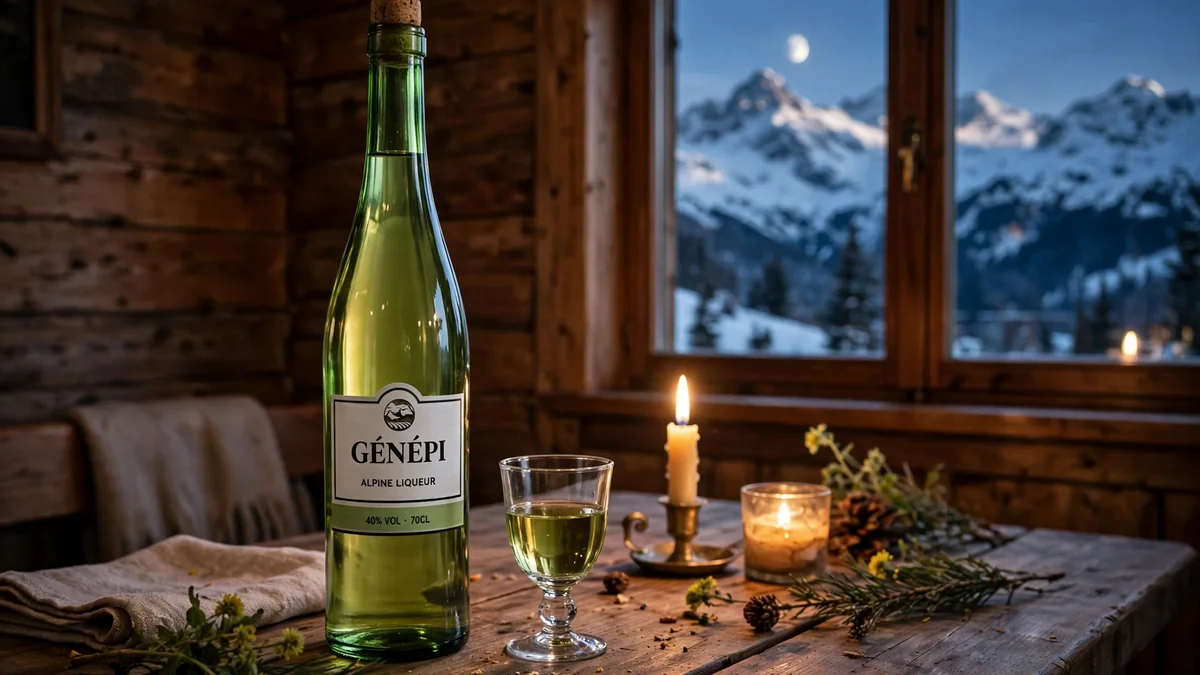
On the shelf, a green bottle waits, and the meal is already over.
Chilled, in a small glass, that is how the valley drinks it.
It closes the evening the way the slopes close the day: quietly, after the work is done.
Alcohol abuse is dangerous for your health. Drink in moderation.
Génépi in Short
- Génépi is the alpine liqueur made from the wormwood plant that grows above 2,000 metres (Eyguebelle, 2026).
- Protected by law, the name carries strict making rules.
- Serve it neat, chilled, in a small glass, as a digestif at the end of a meal.
- An hour in the fridge is the right chill (Food Republic, 2026); the freezer is too cold.
- Judge the bottle by the Génépi des Alpes mention on its label, not by the shade in the glass.
- In La Salle-les-Alpes, the 4 Frères distillery makes its own génépi, a short walk from the bar.
What Makes Génépi Génépi
Only one plant earns the name, and it grows where the air thins.
Wormwood is a small alpine plant, an Artemisia, gathered on high slopes across the French, Italian, and Swiss Alps (Useful Temperate Plants, 2026).
Above 2,000 metres it grows, in rocky, south-facing terrain, and the harvest comes in late summer.
Steeped in neutral alcohol and sweetened, the plant becomes the liqueur (Food Republic, 2026).
Herbs join it in the bottle, and the finished drink carries their herbal, floral complexity.
Génépi des Alpes is a geographical indication, and it protects how the liqueur is made (Qualigeo, 2026).
Wormwood leads the rules: at least 85% of the plants by weight in maceration (Qualigeo, 2026).
Distillation keeps the share at 50% or more (Qualigeo, 2026).
Dried plants macerate at least 20 days, fresh ones at least 15, under the same rules (Qualigeo, 2026).
Thirty percent alcohol is the floor for the finished liqueur, served at the end of a meal (Qualigeo, 2026).
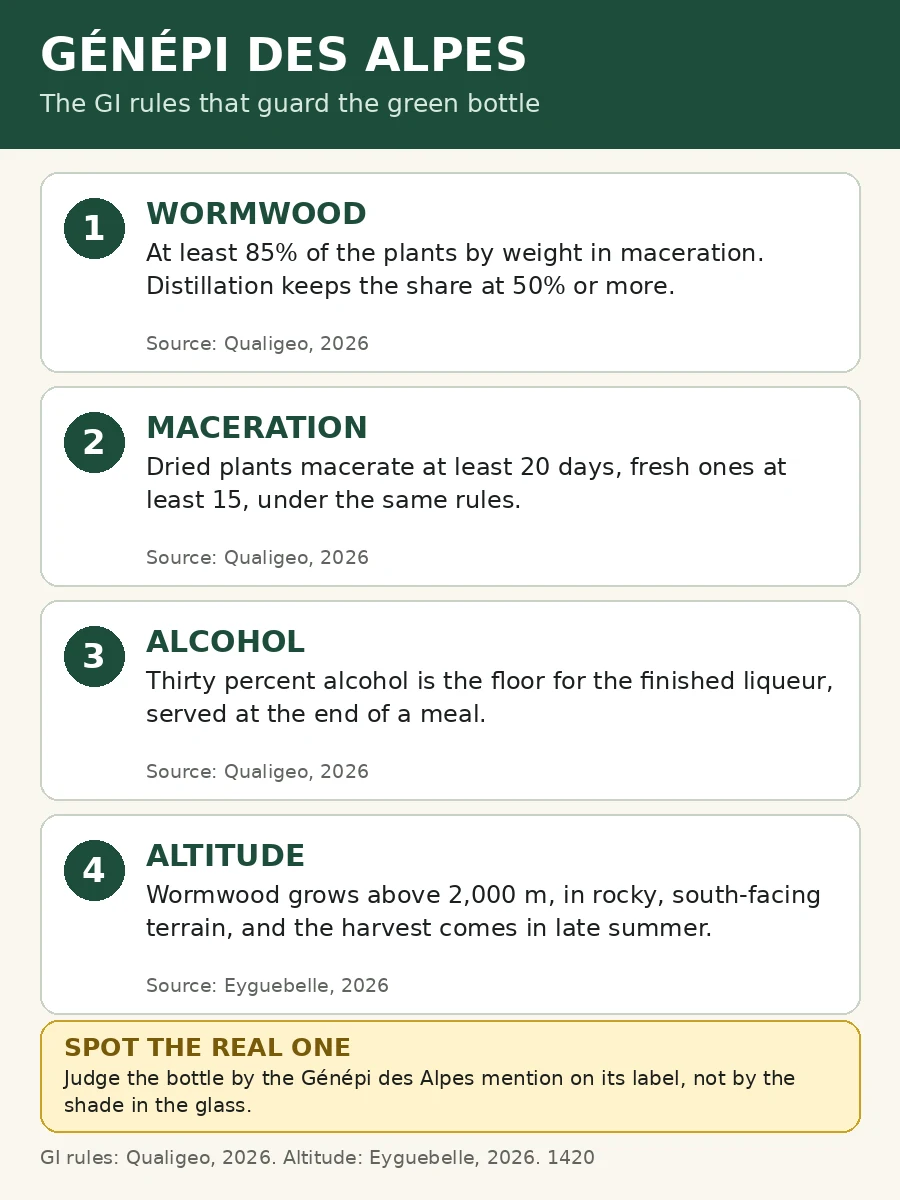
Four GI rules guard the green bottle, from wormwood share to altitude. Eyguebelle, not Qualigeo, supports the 2,000 m rule.
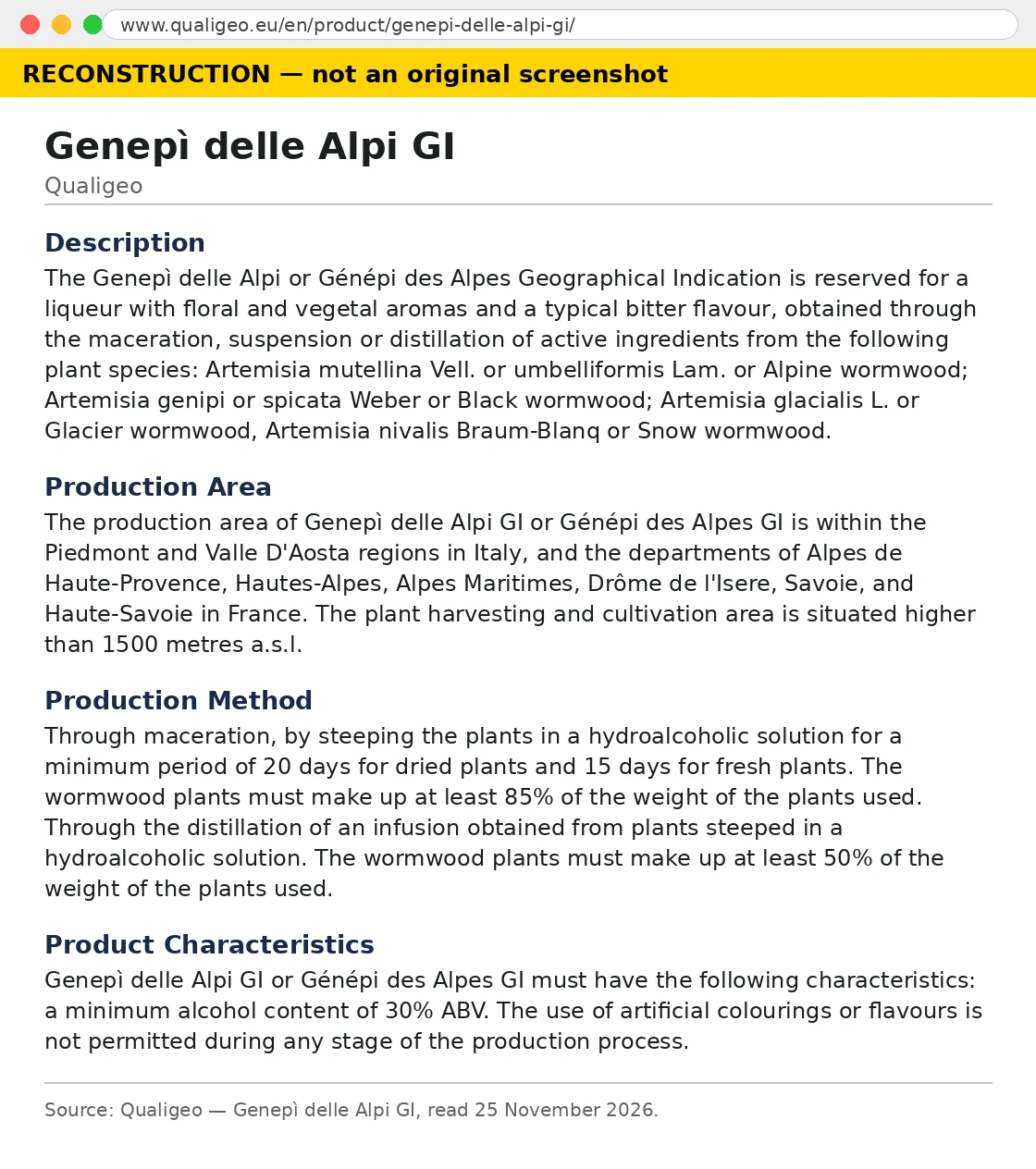
Qualigeo states the GI rules verbatim on its entry page. Harvest ground sits higher than 1,500 metres, not 2,000.
How to Serve It
Neat is the classic serve, and the glass stays small.
Pour it after the plates clear, when the meal is done and the table is talking.
Sixty minutes in the refrigerator before serving is the perfect temperature, one guide advises (Food Republic, 2026).
Chilled, not frozen: cold flattens nothing here, but ice numbs the herbs.
Some bottles suggest 6 to 8°C, very chilled, to show their aromatic finesse (Cave Le Mouton Rouge, 2026).
Room temperature works too, and mountain drinkers have poured it both ways for generations.
Ice is a choice, not a mistake: a single cube softens the first sip without drowning it.
Tonic and lemon turn it into a lighter drink, an alpine answer to gin (Food Republic, 2026).
Hot chocolate takes it too, laced with génépi, and the cocoa suits the herbs (Food Republic, 2026).
Drops on a sugar cube, dipped in coffee, make the French “canard” (Bouchon, 2026).
Over lemon sorbet, it cleanses the palate between courses (Bouchon, 2026).
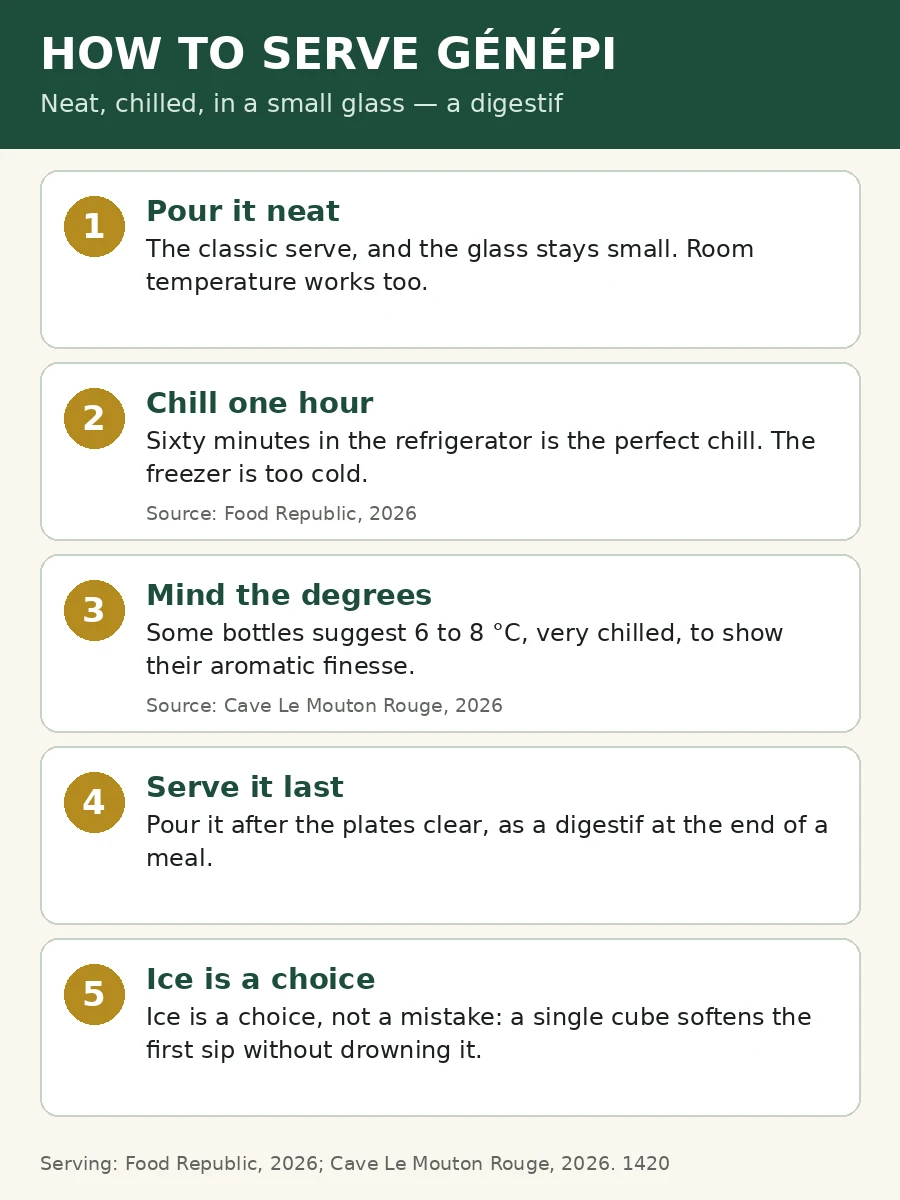
Five steps take génépi from bottle to digestif glass. Sixty minutes in the fridge is the chill the draft recommends.
The Colour Trap
Green is the bottle, not the proof, and the shade in the glass varies.
Some génépi pours pale yellow-green, and some pours amber, and neither shade ranks the bottle.
Makers macerate differently, and the plant’s own colour shifts with the harvest.
Its label decides instead: the words Génépi des Alpes mean the making rules were followed.
Without that mention, the bottle may still be génépi, but the guarantee is gone.
Souvenir bottles trade on the colour, and the label tells the truer story.
Read the label the way the label guide teaches, line by line: How to Read a French Wine Label Before You Order It.
Buying the Real One
Buy where the maker pours, and the bottle’s story stays honest.
Distillerie des 4 Frères makes its own génépi, a short walk from the bar in La Salle-les-Alpes.
Their liqueurs include génépi beside mélèze, framboise, and verveine citronnée, from plants gathered locally (Village Artisanat, 2026).
At the distillery shop, the brothers pour what they sell, and the visit runs an hour with a tasting offered (Distillerie des 4 Frères, 2026).
The distillery guide tells how it works, and what else it makes, in full: The Distillery Next Door.
Prices vary by maker and bottle size, and no single price defines the drink.
Ask at the counter what is pouring, because the range follows the harvest.
A bottle bought at the distillery carries the valley with it, and the label proves it.
Génépi Beyond the Glass
Cocktails take génépi further, and the herbs travel well.
Shake two ounces of cognac with one ounce each of génépi and fresh lemon juice for a strong yet sippable sidecar (Food Republic, 2026).
Stir it into a Manhattan, and the floral intensity changes the drink entirely (Food Republic, 2026).
Swap it for green Chartreuse in a bijou, and the flavour pairs with gin, sweet vermouth, and orange bitters (Food Republic, 2026).
A dash in Scotch and soda adds an alpine twist, with a lemon peel on top (Food Republic, 2026).
In the kitchen, it flavours sauces and marinades with a herbal note (Distilleries de Provence, 2026).
Poured over pear sorbet, it turns dessert into a digestif (Distilleries de Provence, 2026).
One Tourmente beer carries the same plant, and génépi flavours a pale ale too: La Tourmente: The Local Beer of the Hautes-Alpes.
Génépi and Chartreuse: Cousins on the Shelf
Two green bottles share the shelf, and drinkers mix them up.
Monks further north make Chartreuse from 130 herbs, plants, and flowers (Wikipedia, 2026).
Chartreuse green runs 55% alcohol and yellow 43%, both above génépi’s 30% floor (Wikipedia, 2026).
Gentler of the two cousins, it earns praise as among the best Chartreuse alternatives (Food Republic, 2026).
Start with génépi when the herbs should whisper, and reach for Chartreuse when they should shout.
Every expression, green and yellow and V.E.P., waits in the Chartreuse guide: Chartreuse: Green, Yellow, and V.E.P. — What the Mountain Liqueur Actually Is.
Frequently Asked Questions
How do you drink génépi?
Drink it as a digestif, at room temperature or chilled, at the end of a meal (Eyguebelle, 2026).
An hour in the fridge is the ideal chill, and a small glass holds it (Food Republic, 2026).
How strong is génépi?
The geographical indication sets the floor at 30% alcohol (Qualigeo, 2026).
Individual bottles run stronger, and the label states the strength.
Is the colour a sign of quality?
No: génépi pours pale yellow-green in some bottles and amber in others, and the shade varies by maker.
Judge the bottle by the Génépi des Alpes mention on its label, not by its colour.
Where can I buy real génépi in Serre Chevalier?
At the Distillerie des 4 Frères in La Salle-les-Alpes, where the brothers make and pour their own (Distillerie des 4 Frères, 2026).
About an hour long, the visit ends with a tasting.
Can I mix génépi in cocktails?
Yes: it works in a sidecar, a Manhattan, and a bijou, and a dash lifts Scotch and soda (Food Republic, 2026).
Neat stays the classic serve, and cocktails are the second act.
Methodology
Qualigeo’s Génépi des Alpes entry and the Serre Chevalier tourist office supplied the génépi rules, checked 25 November 2026.
Serving guidance comes from Food Republic, Distilleries de Provence, Eyguebelle, and Bouchon, checked the same day.
Distillery facts rest on the distillery’s own site, checked the same day.
Nothing was tasted and nothing bought; no bottle is recommended here.
References hold the sources; every fact above was checked against them by hand.
References
- Genepì delle Alpi GI | Qualigeo
- What Makes Alpine Liqueur Unique | Food Republic
- Génépi, the liqueur of the Southern Alps | Distilleries de Provence
- 7 incredible things you need to know about Genepi alcohol | Eyguebelle
- Distillerie et Domaines de Provence Liqueur de Genepi 40% | Bouchon
- Distillerie des 4 Frères — homepage
- Chartreuse (liqueur) | Wikipedia
- Distillerie des 4 Frères — Village Artisanat
- Genepi Abrupt — Cave Le Mouton Rouge
- Artemisia umbelliformis — Useful Temperate Plants