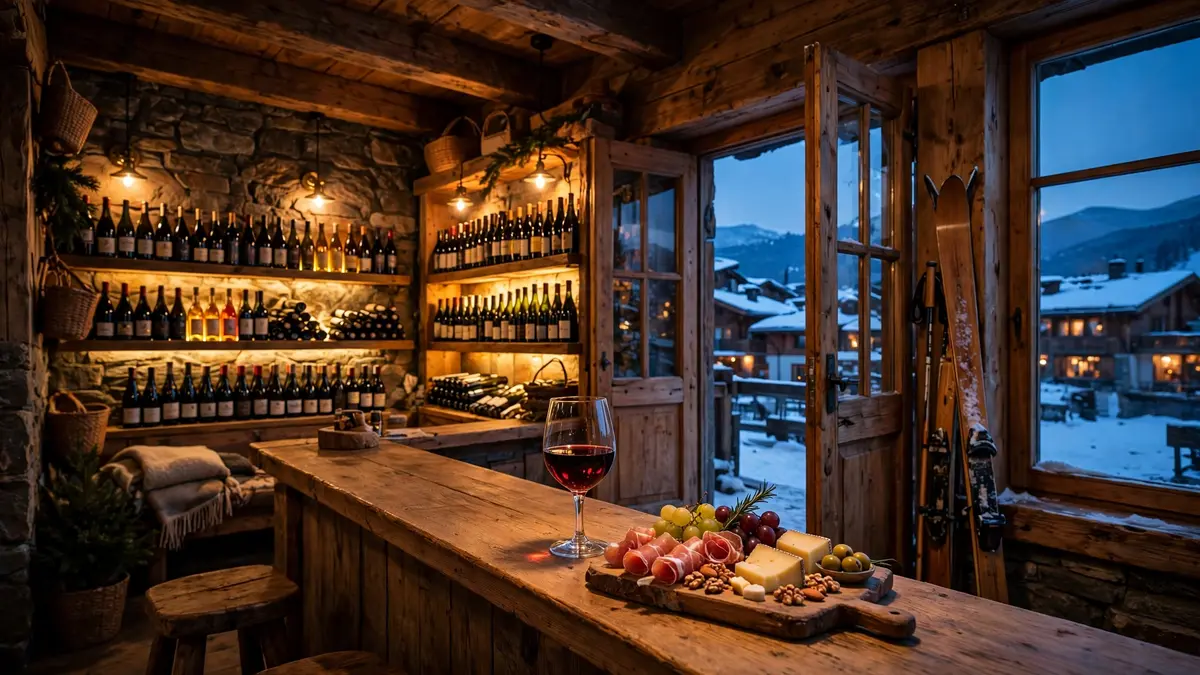
Main image: AI illustration.
Wine in Serre Chevalier starts where the last run ends: a small bar in Villeneuve, 1,420 metres up, with skis still leaning by the door.
It pours at Le 1420, a wine and spirits bar named after its own altitude.
Its cellar holds the valley’s whole drinking story, from a 2014 wine carte to ten bottles of Chartreuse.
Pour local first, then read the carte: the valley’s story runs bar, cellar, table.
Start local, then go wide: the first glass belongs to the valley, and the carte earns its second look after that.
Alcohol abuse is dangerous for your health. Drink in moderation.
Wine in Serre Chevalier in Short
- At 1,420 metres, Le 1420 stands where Villeneuve meets the slopes.
- Across eight categories, from Chartreuse to champagne, the old shop stocked 54 bottles.
- Named producers stand behind eleven French wine regions on the 2014 carte.
- Beyond the carte, the valley makes its own drink too: Tourmente beer, génépi, and the 4 Frères liqueurs.
The Bar at 1,420 Metres
Villeneuve holds the bar, and the bar holds the name of its own height.
Set at 1,420 metres in Villeneuve, the bar meets the slopes at the village edge (Serre Chevalier tourist office, 2026).
The name is the address and the altitude in one word: fourteen hundred and twenty metres above the sea.
Four villages share the valley floor, and Villeneuve sits third-lowest in height among them.
Neighbouring villages climb from Briançon at 1,200 metres to Le Monêtier-les-Bains at 1,500 metres (ski.fr, 2026).
Halfway along, the villages read 1,350 metres for Chantemerle and 1,400 for Villeneuve (ski.fr, 2026).
Inside, the bar pours wine first and everything else second.
Wine leads the list, with local beer and spirits beside it on the same shelf.
Evenings fill with live music, DJ sets, and sport on screen (Serre Chevalier tourist office, 2026).
A stylish wine and spirits bar, one travel guide calls it, known for its huge selection of wines and regular DJ nights (Erna Low, 2026).
Local charcuterie platters anchor the food, the same guide notes, and the bar keeps that table simple (Erna Low, 2026).
Charcuterie and cheese arrive on home-made boards beside the beers.
No white tablecloths, no tasting menu: the bar serves drinkers who came straight from the slopes.
Boots stay on, jackets stay on, and the glass arrives before the food does.
That order matters: the bar is a place to drink first and eat alongside, not a restaurant with a bar attached.
Villeneuve also holds the liveliest après-ski in the valley, with the bar at its centre.
Other villages stay quieter after dark, and Monêtier keeps the calmest evenings of the four.
The Valley Behind the Bar
One valley, four villages, and a single ski area tie the bar to its slopes.
Between them runs the Guisane river, over 27.7 kilometres of valley floor (Serre Chevalier tourist office, 2026).
Lowest in the east, Briançon sits at 1,200 metres, and highest in the west, Le Monêtier-les-Bains sits at 1,500 metres (ski.fr, 2026).
Chantemerle and Villeneuve sit between them, sharing one lift pass and one piste network.
| Village | Altitude | Commune |
|---|---|---|
| Briançon | 1,200 m | Briançon |
| Chantemerle | 1,350 m | Saint-Chaffrey |
| Villeneuve | 1,400 m | La Salle-les-Alpes |
| Le Monêtier-les-Bains | 1,500 m | Le Monêtier-les-Bains |
Village bases by altitude (Table 1). Village altitudes from ski.fr resort pages, read 23 November 2026.
Top of the valley, Le Monêtier-les-Bains stands 300 metres above Briançon on the floor.
Chantemerle, at 1,350 metres, belongs to Saint-Chaffrey, the valley’s middle step.
Settled at 1,400 metres in La Salle-les-Alpes, Villeneuve hosts the wine bar 20 metres higher.
Briançon is the valley’s working town, home to over 10,000 people beside the slopes (Serre Chevalier tourist office, 2026).
Briançon is also France’s highest city, a working town with a railway station and a gondola to the slopes.
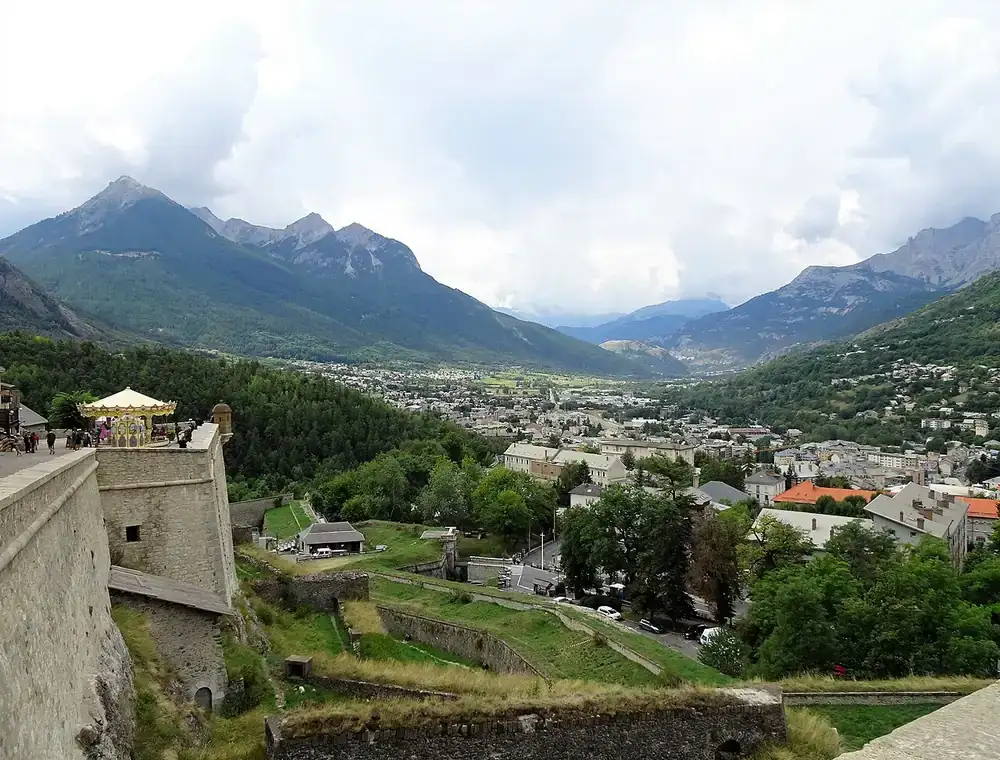
Above these villages, the ski area counts 250 kilometres of pistes, 82 runs, and 58 lifts (Serre Chevalier tourist office, 2026).
Eighty-two runs sounds like a lot until the vertical is counted: 1,600 metres from base to top.
Top elevation reaches 2,800 metres, and the base sits at 1,200 metres (Wikipedia, 2026).
Winter 2026/27 runs 5 December to 18 April (Serre Chevalier tourist office, 2026).
Prorel ends two weeks sooner, on 4 April 2027, as the Briançon sector (InTheSnow, 2026).
France counted 56.1 million skier days in winter 2025/26, first in the world ahead of Austria (Domaines Skiables de France, 2026).
Also France’s best since 2014/15, the same source reports of that season (Domaines Skiables de France, 2026).
High-season prices on these slopes run €68 for an adult day pass and €345 for six days in 2026/27 (Serre Chevalier, 2026).
High season asks €903 for a season pass, the same tariffs show (Serre Chevalier, 2026).
Those prices matter here for one reason: the bar is where the day’s spending ends, not where it starts.
Olympic freestyle skiing and snowboard reach Serre Chevalier at the 2030 Winter Olympics, 1 to 17 February (SnowBrains, 2026).
Drawn up in June 2026, the venue masterplan brings the world to the valley before the decade ends (SnowBrains, 2026).
All the valley numbers, with sources, the statistics article sets out in full: Serre Chevalier in Numbers 2026.
Beside them sit the ski area’s own numbers: Serre Chevalier Ski Area: 250 Kilometres, 82 Runs, 58 Lifts.
France’s record season has its own story too: France Counts 56.1 Million Skier Days in 2025/26, First in the World.
Lift pass prices for the season are set out here: Serre Chevalier Lift Pass Prices 2026/27: €68 a Day, €345 a Week.
And the Olympic plans are here: Serre Chevalier to Host Freestyle Skiing at the 2030 Winter Olympics.
The Cellar: 54 Bottles on One Shelf
Behind the bar stands a cellar, and behind the cellar stands a shop that closed in 2023.
By the bottle, the old 1420 shop stocked its shelves, and its catalogue of 2021–2023 still lists every one of them (1420 shop catalogue, 2021–2023).
Fifty-four bottles filled those shelves, across eight categories that say more than any single bottle could.
| Category | Bottles |
|---|---|
| Chartreuse | 10 |
| Champagne | 10 |
| Gin | 10 |
| Beer | 9 |
| Rum | 7 |
| Whisky | 3 |
| Juice | 3 |
| Soda | 2 |
Old shop shelf by category (Table 2). Counts from the 1420 shop catalogue, 2021–2023.
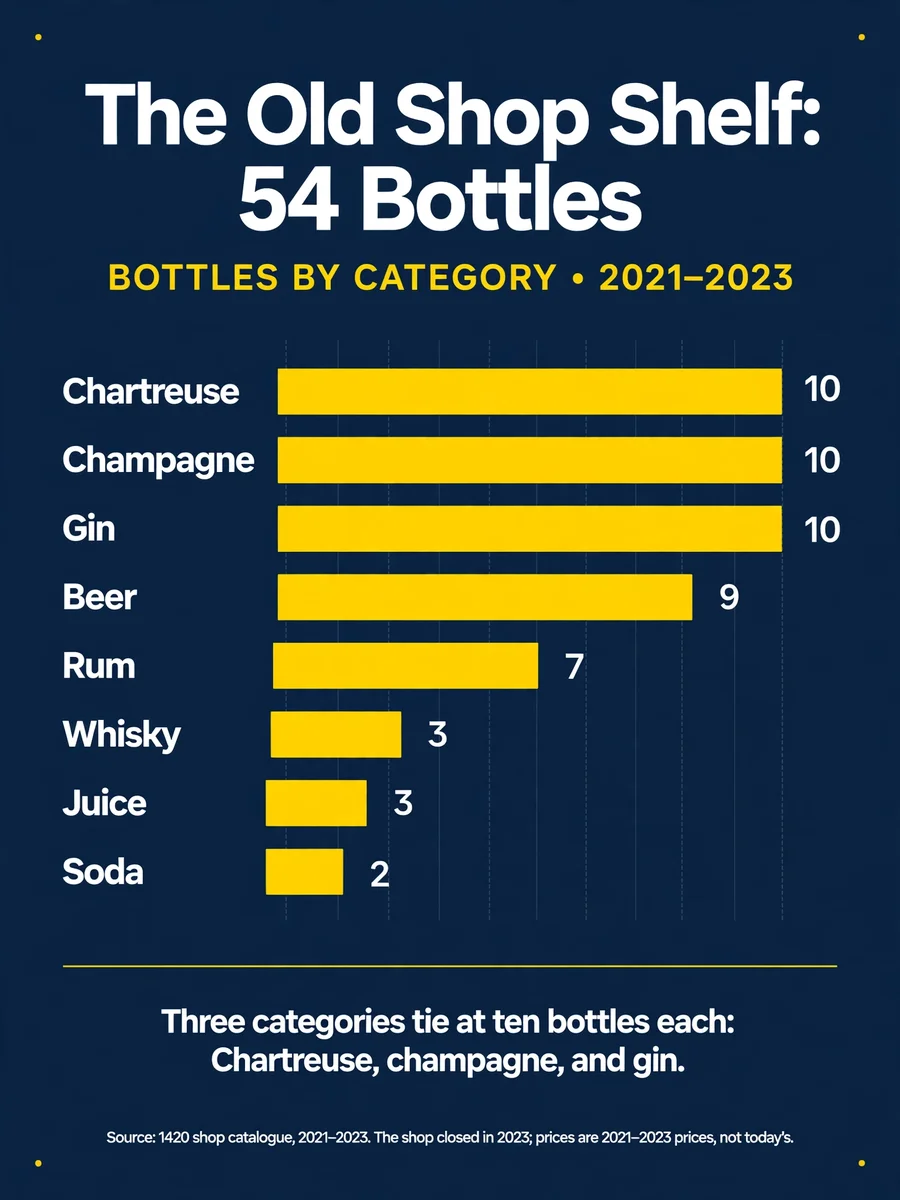
Three categories tie at ten bottles each: Chartreuse, champagne, and gin.
Beer follows with nine, all of them one local brewery’s range.
Rum holds seven, whisky three, and the soft drinks close the list with three juices and two sodas.
Single liqueur, ten bottles: the old shop’s shelves ran deeper for Chartreuse than for nine beers or ten champagnes (1420 shop catalogue, 2023).
Depth mattered most: the shop sold drinks to drink, not souvenirs to keep, and every shelf showed the full range.
Least room of any alcoholic shelf went to beer: nine Tourmente beside ten gins, seven rums, and three whiskies in all (1420 shop catalogue, 2023).
With the beers on the shelf: three juices, two sodas (1420 shop catalogue, 2023).
Champagne ties Chartreuse at ten bottles, and that tie tells its own story.
Ten champagnes on the shelf means a mountain bar expects celebrations, not just thirst.
Against city standards, fifty-four bottles is a small cellar, and that smallness is the point.
Every bottle earned its place by belonging to the valley’s evenings, not by filling a warehouse.
Catalogue prices are 2021–2023 prices, not today’s; the shop closed in 2023.
Current prices appear nowhere in this guide, because no current price list survives.
What survives is the shape of the shelf, and the shape is the story.
The 2014 Carte: Eleven Regions on One Page
Before the shop, there was the carte, and the carte is older than the catalogue by nine years.
Grouped by region, the 2014 carte’s red wines still explain the system better than any diagram.
Eleven regions appear on that red list, producers named beside each one, none left out (1420 carte, 2014).
| Region | Producers on the carte |
|---|---|
| Loire | Chinon, Domaine René Couly; Saumur Champigny, Les Chassoirs; Sancerre, Comte Lafond |
| Bourgogne | Mercurey, La Framboisière by Faiveley; Nuit Saint Georges, Croix de Challand |
| Beaujolais | Brouilly, Chapelle Venenge; Fleurie, Domaine des Marrans |
| Savoie | Mondeuse, Terre de Famille |
| Hautes-Alpes | Domaine Petit Août, Cuvée Mémoire Neuve |
| Rhône | Crozes-Hermitage, Vidal Fleury |
| Bordeaux | Saint-Émilion Grand Cru, Château Carteau |
| Provence | Named on the carte |
| Languedoc-Roussillon | Named on the carte |
| Sud-Ouest | Named on the carte |
| Foreign | Lacryma Christi, Italy; Banrock Station, Australia; Rioja Crianza, Spain |
Red-wine carte of 2014 by region (Table 3). Regions and producers from the 1420 carte, 2014.
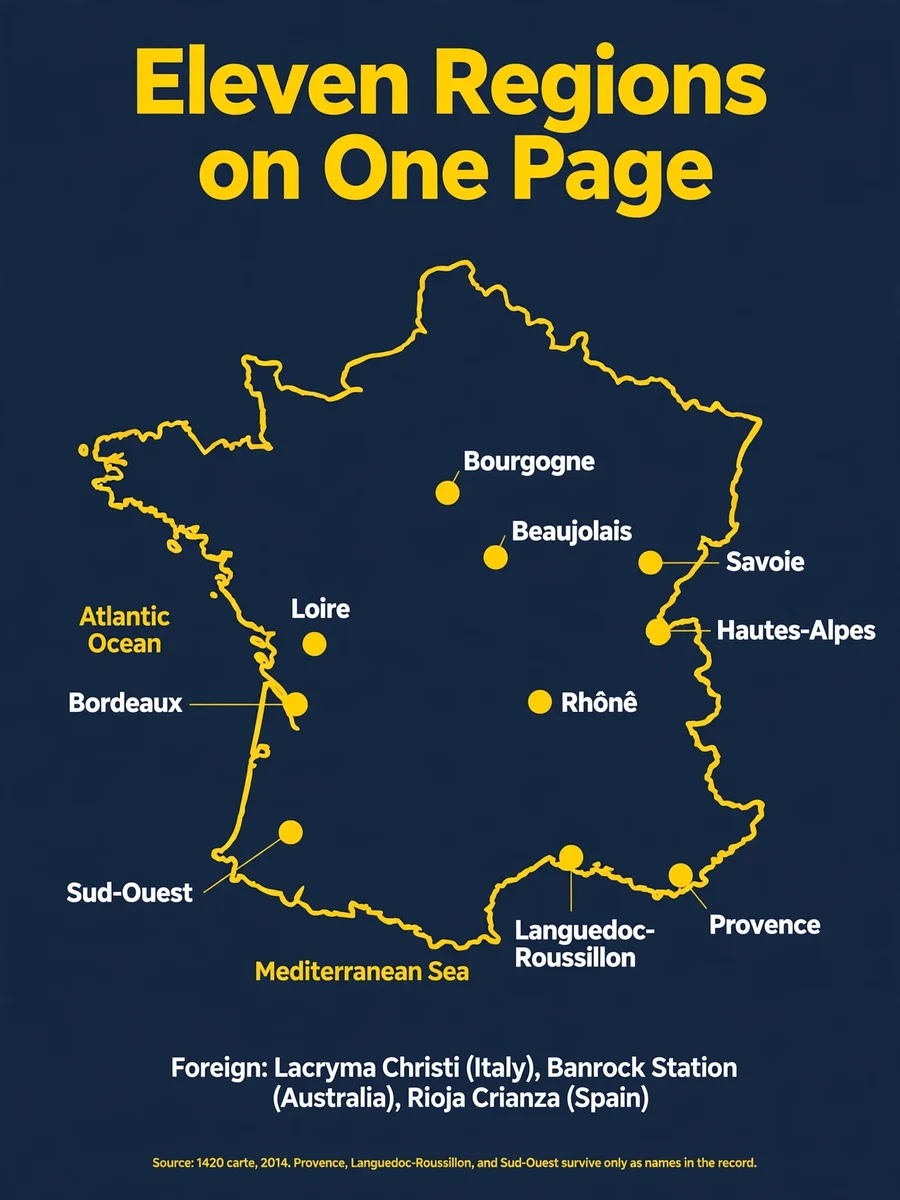
Chinon (Domaine René Couly), Saumur Champigny (Les Chassoirs), and Sancerre (Comte Lafond) open the Loire row (1420 carte, 2014).
Mercurey (La Framboisière by Faiveley), Nuit Saint Georges (Croix de Challand): the Bourgogne row in full (1420 carte, 2014).
Brouilly (Chapelle Venenge) and Fleurie (Domaine des Marrans) are the two Beaujolais crus on the list (1420 carte, 2014).
Mondeuse (Terre de Famille) stands for Savoie, and Domaine Petit Août’s Cuvée Mémoire Neuve for the Hautes-Alpes (1420 carte, 2014).
Crozes-Hermitage (Vidal Fleury) closes the Rhône row, and Saint-Émilion Grand Cru (Château Carteau) the Bordeaux one (1420 carte, 2014).
Lacryma Christi (Italy), Banrock Station (Australia), and Rioja Crianza (Spain) close the page as the foreign bottles (1420 carte, 2014).
Three regions survive only as names in the record: Provence, Languedoc-Roussillon, and Sud-Ouest.
Their producers do not survive in the archived capture, and this guide does not invent them.
What the 2014 capture shows is names and producers, never a price (1420 carte, 2014).
A carte without prices is a map, not a menu, and this guide reads it as one.
Colour changes nothing here: a Provence rosé reads like a Bordeaux red.
Savoie borders the Hautes-Alpes to the north, and its Mondeuse grows a short drive from the bar.
Hautes-Alpes itself makes wine too, and the carte proves it with a single named estate.
Eleven regions, one local bottle: a small share, and the smallness is honest.
Imported wine fills most of the carte, and the list never pretends otherwise.
How to Read the Carte Like a Local
Ground first: wine law starts there — the place comes before the brand.
Soil, slope, climate, and local ways of working them: that is the terroir, that place (INAO, 2026).
Name a place on the label, and it promises the wine was made there, under that place’s rules (INAO, 2026).
Tiers sort French wine three ways, and the bottle’s label names its tier (INAO, 2026).
| Tier | What it means | What it guarantees |
|---|---|---|
| AOP / AOC | Top tier: one place, one rulebook | Every step follows local know-how in one area |
| IGP | Middle tier: a wider area, looser rules | Grapes mostly from the named area |
| Vin de France | Base tier: no place claim | The wine is French, and little else is promised |
French wine tiers (Table 4).
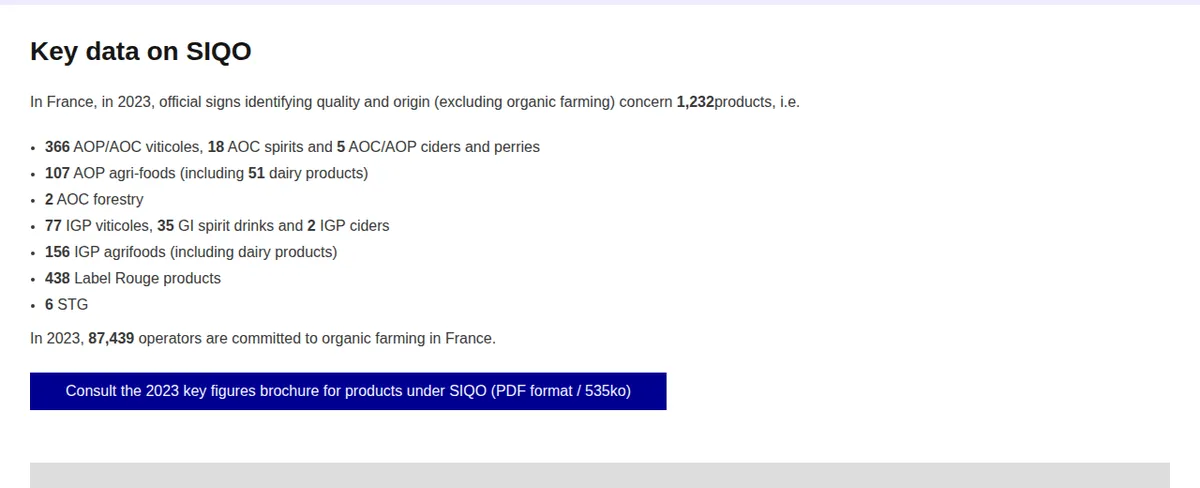
In 2023 the count put 77 wines under IGP and 366 under AOP or AOC (INAO, 2026).
In 2018, AOC wine took 47% of French production (Wikipedia, 2026).
Pick AOP for the place, IGP for the grape or the price.
Table wine takes Vin de France: French, honest, no place promised.
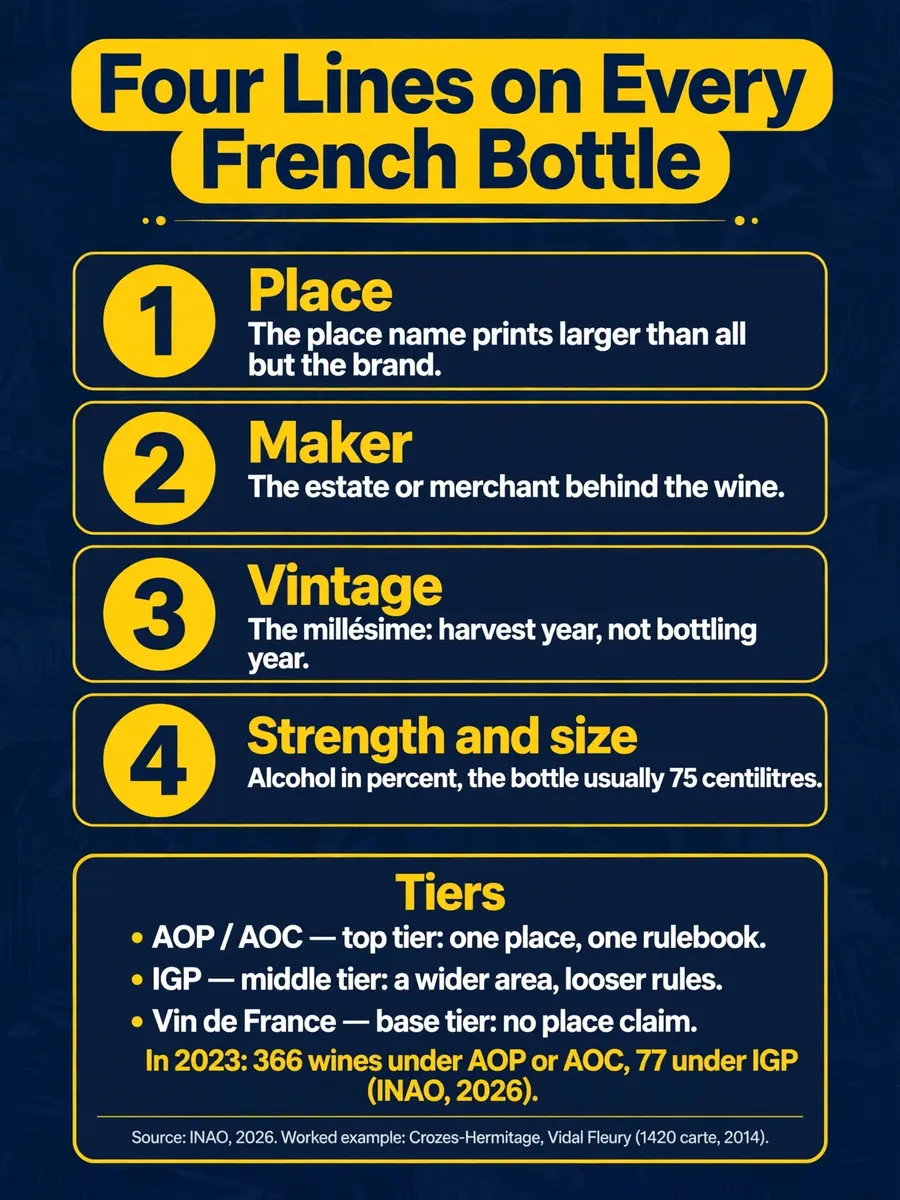
Check four lines on every French bottle: place, maker, year, strength.
Look for the place name first: it prints larger than all but the brand.
Producer comes second: the estate or merchant behind the wine.
Vintage comes third, the millésime: harvest year, not bottling year.
Fourth come strength and size: alcohol in percent, the bottle usually 75 centilitres.
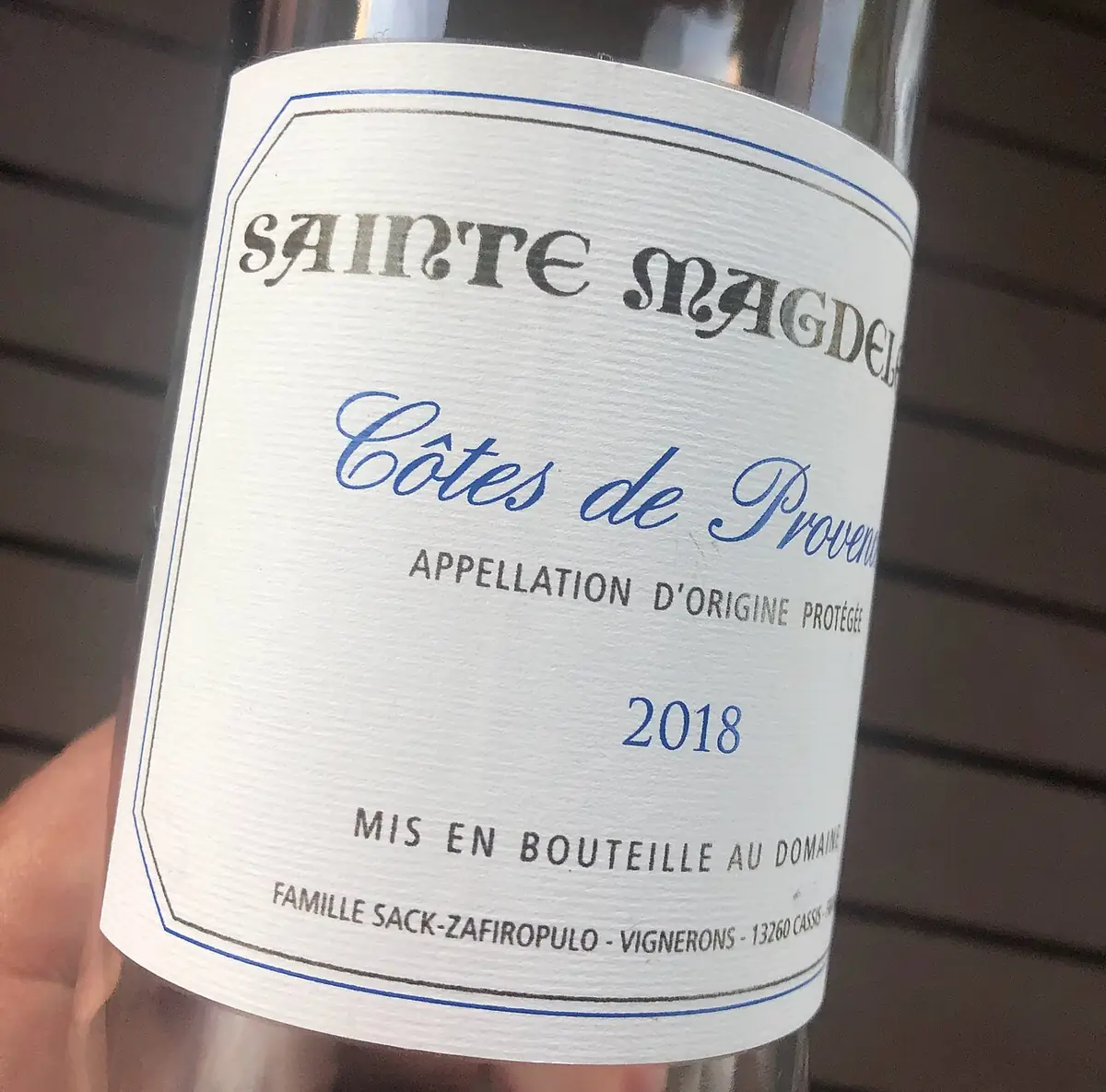
Read the strength off the label’s number: it runs light to strong.
“Mis en bouteille au château” signals estate bottling; “mis en bouteille” alone, bottling elsewhere.
Check the four lines first, before the artwork — then the gamble ends.
Pictures, gold foil, old-looking crests: none of them promises anything — only the appellation line does.
Pick a Rhône red from the carte: Crozes-Hermitage, Vidal Fleury (1420 carte, 2014).
First the place: Crozes-Hermitage names it, a northern Rhône hillside stretch.
Maker second: Vidal Fleury made it, and the bottle’s vintage dates its harvest.
Sixty seconds with the four lines tells you what the bottle is.
For the full minute-by-minute read, follow the label guide.
It walks the same four lines with worked examples: How to Read a French Wine Label Before You Order It.
Read in a minute, the bottle gives up its four lines: that is all a French label asks.
The Local Shelf: What the Valley Makes Itself
Most of the carte comes from elsewhere, and the guide says so plainly.
Yet the valley makes its own drink too, and its own shelf runs deeper than that single bottle suggests.
Local makers fill it, four in number: one wine estate, one brewery, one distillery, and one order of monks from further north.
Domaine Petit Août stands for the valley’s own wine: Cuvée Mémoire Neuve, from the Hautes-Alpes (1420 carte, 2014).
Single estate, single cuvée, and no other local wine on the carte: that is the whole local wine story in 2014.
Next door sits Savoie, and its Mondeuse from Terre de Famille is the nearest neighbour on the list (1420 carte, 2014).
Mondeuse is Savoie’s dark grape, and the bottle on the carte carries the region’s name first.
Since 1998, the Briançon brewery has poured deep in the Alps (Untappd, 2026).
La Tourmente’s beers carry their names, and the brewery still works in Briançon today.
Filled with nine Tourmente beers in 33-centilitre bottles, the 1420 shop stocked them all (1420 shop catalogue, 2023).
Every bottle cost €3.50, one flat price for the whole range in the archived catalogue (1420 shop catalogue, 2021–2023).
Brewed with the mountain plant Génépi, the pale ale runs at 5.1% alcohol (Untappd, 2026).
Grivoise adds red fruits, the session IPA adds hops, and Noël closes the year at 8% alcohol (Untappd, 2026).
Thyme or génépi rides in some Tourmente beers, mountain plants gathered for brewery recipes (Provence-Alpes-Côte d’Azur, 2026).
Flavourings grow on the slopes the drinkers ski, so the range tastes of its home.
Here, local means the beer is brewed where it is drunk, in the same valley — not trucked in from far away.
Beer travels the Guisane valley road from La Salle-les-Alpes down to Briançon.
Each of the nine beers, with its strength, the brewery guide sets out in full: La Tourmente: The Local Beer of the Hautes-Alpes.
Above 2,000 metres the plant Génépi grows, in rocky, south-facing terrain across the French, Italian, and Swiss Alps (Alpine Times, 2026).
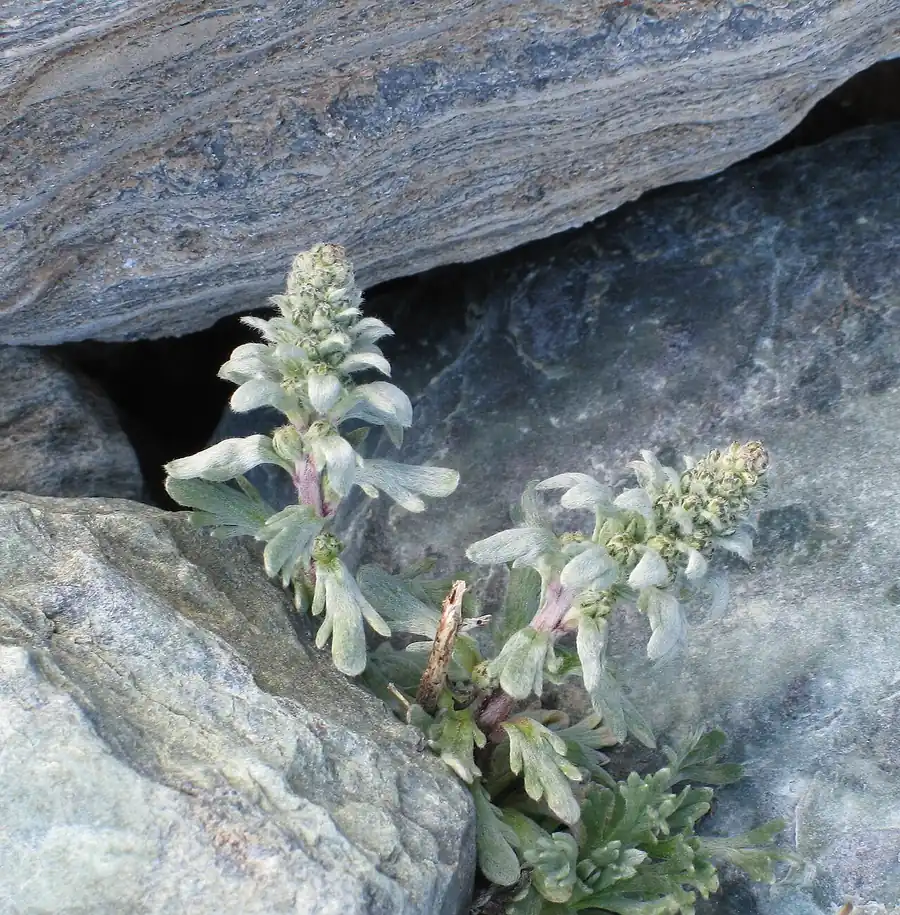
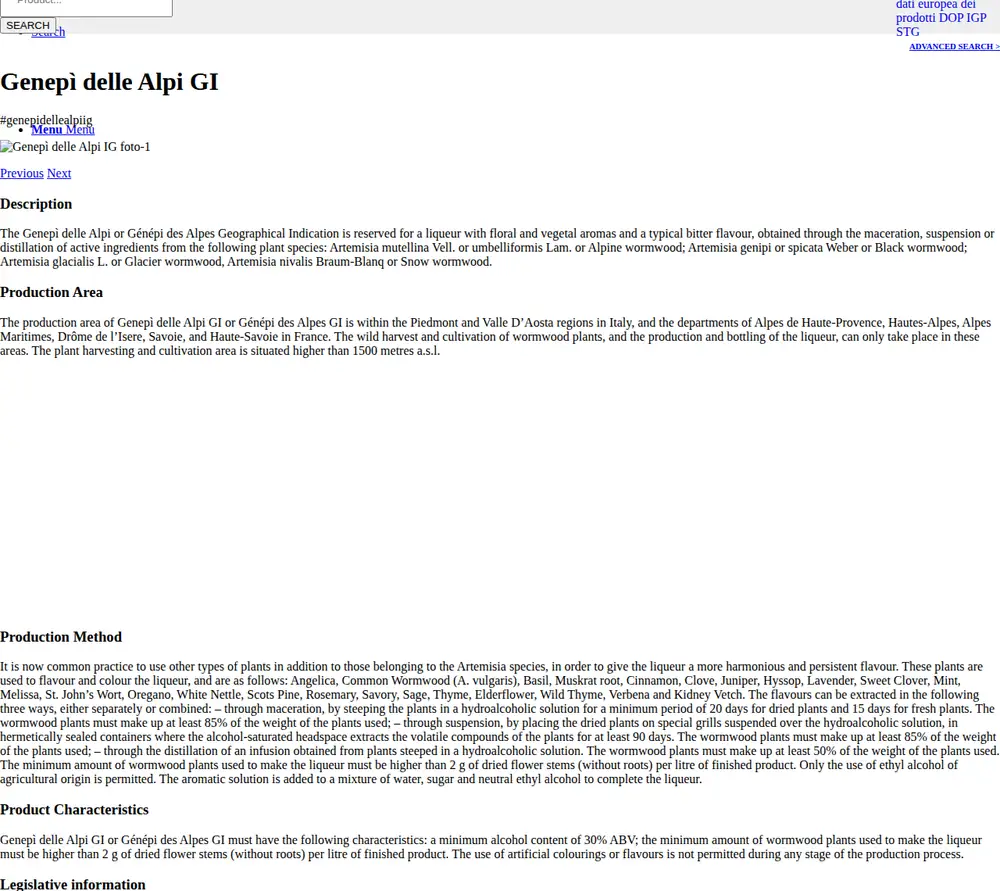
Génépi the liqueur carries a geographical indication, Génépi des Alpes, that protects how it is made (Qualigeo, 2026).
Among its production departments the indication covers the Hautes-Alpes, alongside Savoie and five others (Qualigeo, 2026).
Wormwood plants stand first in its rules: at least 85% of the plants by weight in maceration, and at least 50% in distillation (Qualigeo, 2026).
Maceration runs at least 20 days for dried plants and 15 days for fresh ones, the same rules state (Qualigeo, 2026).
Chilled at the end of a meal, the finished liqueur must reach at least 30% alcohol (Qualigeo, 2026).
Distillerie des 4 Frères turns that plant into bottles a short walk from the bar.
Brothers run it, four of them — Sylvain, Nicolas, Bastien, and Olivier Ribuot — natives of the Serre Chevalier valley (Village Artisanat, 2026).
Their still dates from 1921, a century-old copper heart that the brothers open to visitors (Village Artisanat, 2026).
Liqueurs lead the range: mélèze, framboise, verveine citronnée, and génépi, plus eaux-de-vie from local fruit (Village Artisanat, 2026).
Liqueur and eau-de-vie mix in Le Dahu, the house mystery drink, the same listing notes (Village Artisanat, 2026).
Prune du Briançonnais, the valley’s own plum, becomes La Marmote, an eau-de-vie at 42% alcohol for €40 (Distillerie des 4 Frères, 2026).
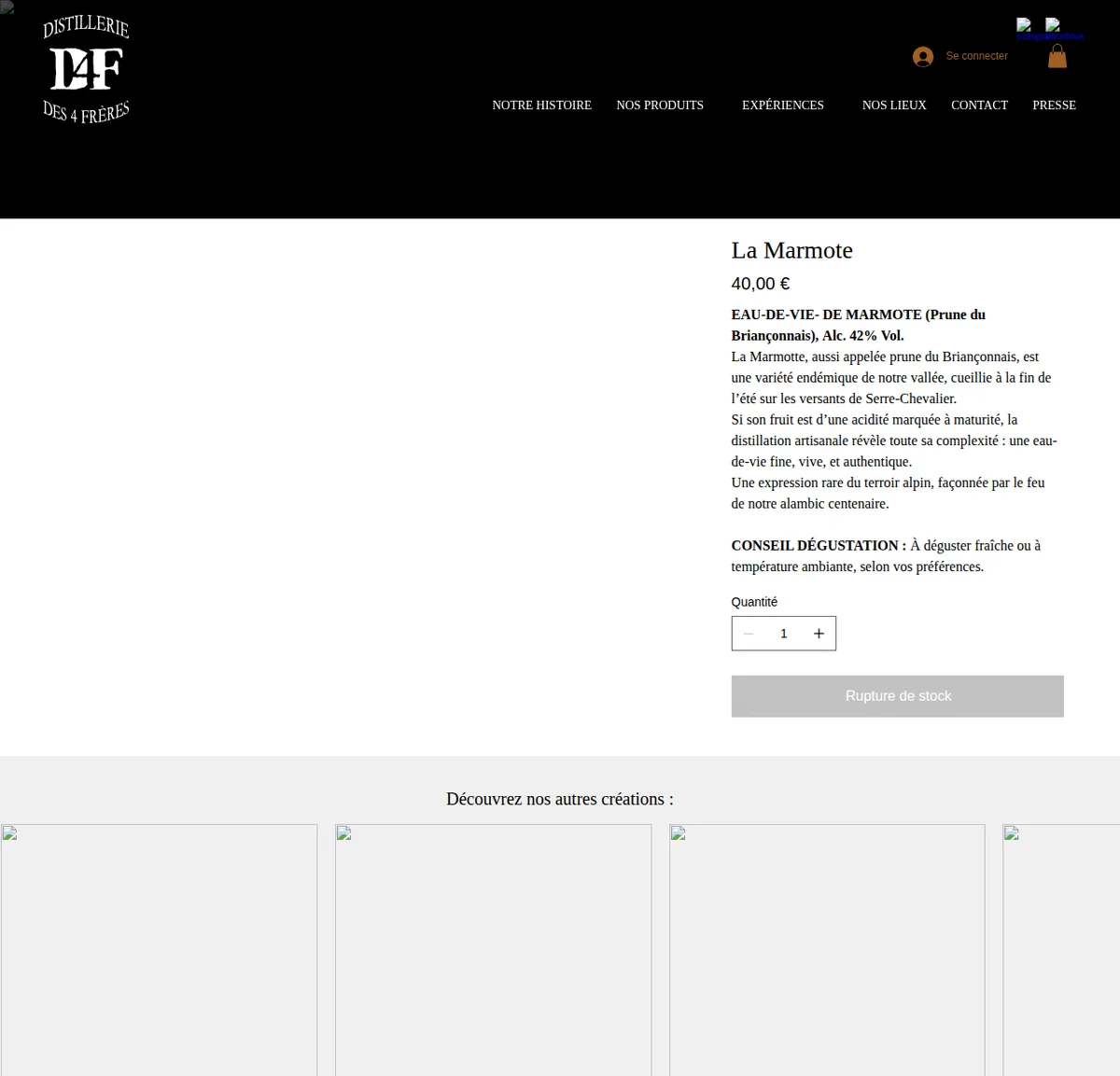
Only here grows that plum, picked late in summer on the slopes of Serre Chevalier (Distillerie des 4 Frères, 2026).
At 6 Rue de la Guisane, 05240 La Salle-les-Alpes, the distillery shop sits in the same village as the bar (Distillerie des 4 Frères, 2026).
Daily the boutique opens from 16 December to 14 April, and Tuesday to Sunday from 1 July to 27 September (Serre Chevalier tourist office, 2026).
Gin distillation workshops run there too, for visitors who want to see the still at work (Serre Chevalier tourist office, 2026).
Chartreuse is the fourth local-adjacent maker, though its monastery stands further north.
On the bar’s shelf sit ten bottles in four expressions, each with its own taste.
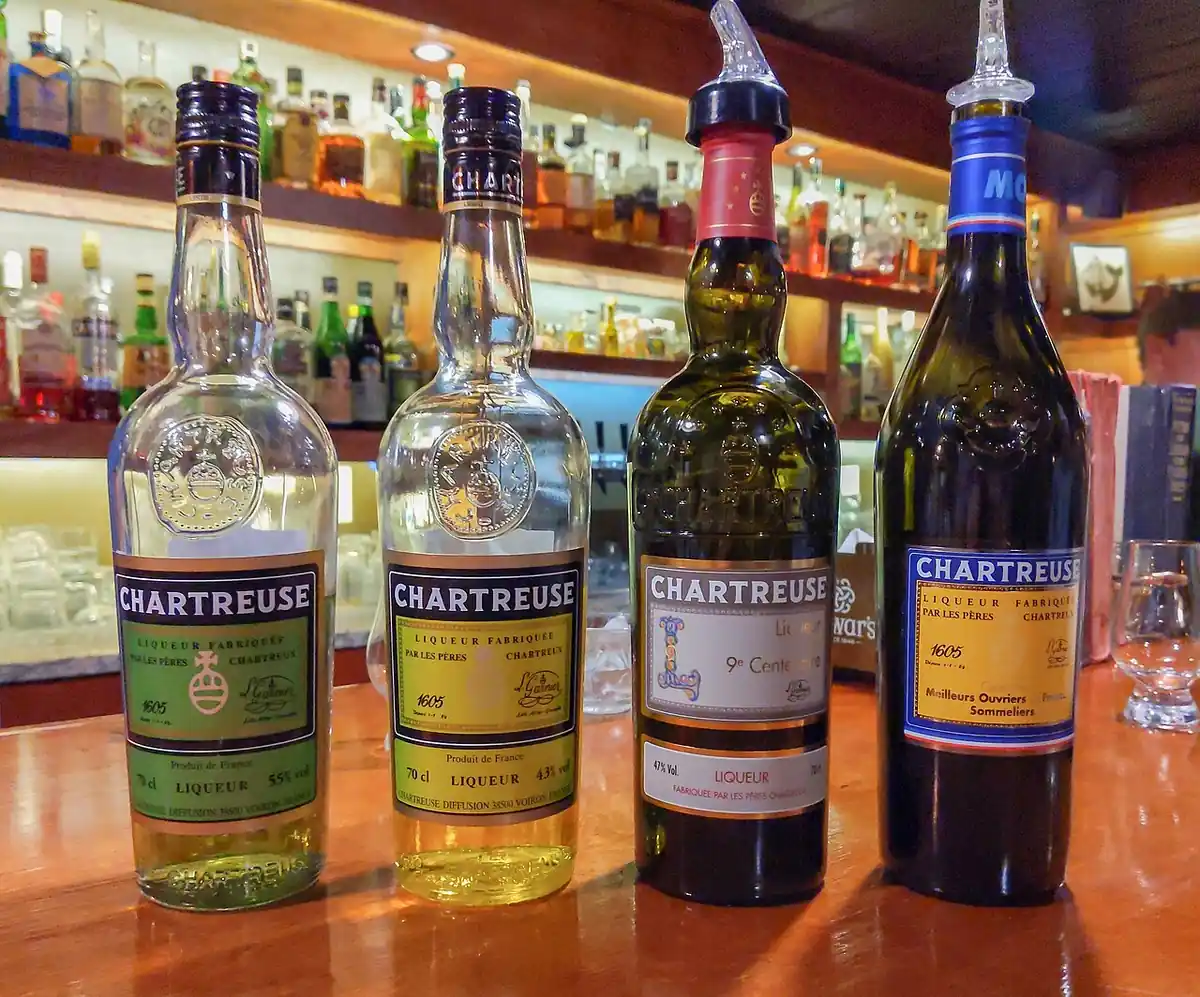
Green Chartreuse stands at 55% alcohol, yellow at 43%, and the Élixir Végétal at 69% (Wikipedia, 2026).
V.E.P. ages the same two liqueurs far longer in oak: green at 54%, yellow at 42% (Wikipedia, 2026).
Two monks prepare the herbal mixture today, from 130 herbs, plants, and flowers (Wikipedia, 2026).
Priced between €15 and €190, the catalogue’s Chartreuse ran from the small Élixir to the yellow V.E.P. (1420 shop catalogue, 2021–2023).
All four expressions the liqueur guide tells in full: Chartreuse: Green, Yellow, and V.E.P. — What the Mountain Liqueur Actually Is.
Four makers, one valley shelf: the estate, the brewery, the distillery, and the monks’ liqueur.
No other bar we found in the valley lines them up this way; the line-up is ours.
Ordering at the Table
Ordering here rewards names, not colours, and the range proves it.
Nine beers, four colours: colour alone will not find your bottle.
Names carry the style — Blonde for the pilsner, Blanche for the wheat beer, Ambrée for the Belgian pale ale.
Choucas, Dahu, Noël: dark, second amber, winter — each needs its name.
Order by name, not by colour: four colours across nine beers, and colour alone cannot find your bottle.
Ask for it neat, in a small glass, when the meal ends.
Serve it cool, never iced: cold flattens the herbs, warmth wakes them.
Narrow rims gather the aromas: small glasses matter more than large ones.
Taste the brewery at its plainest in the Blonde, then the mountain in the Génépi.
Begin with the Blonde: light, local, best cold after a day on snow.
Drinkers who want the mountain flavour will like Génépi; anyone who dislikes herbal beer will not.
Drink the Blonde first, then let the Génépi follow as bottle two.
Noël fits the cold end of a ski day, not a first tasting at lunch.
When the Blonde pours on draught, ask for it; the bottle list covers the rest.
For the Blonde, draught is best: cold, light, fresh from the counter.
Start with green, the strongest herbs at the fairest strength.
Yellow fits drinkers who want softer edges on the same plants.
Long oak ageing makes V.E.P. a collector’s bottle, not a first taste.
Use Élixir Végétal by the drop: it seasons a cocktail, never fills the glass.
By the bottle went the shop’s Tourmente; by the glass goes the bar’s, draught and bottled both.
Shop to bar, the question changed, not the beer: glass or bottle, same brewery.
Takeaway ran through the same counter, bottles going home “à emporter” or arriving “en livraison chez-vous”.
From the old shop that line survives, and the bar keeps the same habit.
November’s printed list will not match March’s poured list, and the bar does not pretend otherwise.
The Table: Boards, Cheese, and What Goes With Them
Charcuterie and cheese boards sit beside the beers at the bar.
Mountain cheese meets amber beer at one table, served together by the bar.
Wooden boards carry the food; amber beer is what the bar pours with them.
Salt, fat, and cold beer: the bar’s own logic runs in that order.
Amber beer suits the cheese better: caramel malt meets mountain cheese, and neither shouts over the other.
Red wine suits the charcuterie too, when the table wants wine instead of beer.
Crozes-Hermitage from the carte stands up to cured meat without overpowering it.
Sancerre suits a different board: white wine for the milder cheeses, where red would dominate.
Génépi closes the meal, not the board: chilled, in a small glass, after the plates clear.
Green as a digestif, neat, in a small glass: Chartreuse does the same job from the other side of the shelf.
Champagne suits the start of the evening, before the boards arrive.
Ten champagnes on the old shelf say the bar expects toasts, and the table should use them.
Behind the counter hides no full kitchen, and this guide does not claim one.
Food here means boards, and the guide judges them on their own terms.
Boards suit a table that shares; they do not suit a diner who wants a plated main course.
Eat in the village first, then come to the bar for the glass.
Water sits on the table too, and the guide counts it as part of the order.
Altitude dries the mouth faster than the valley floor, and a glass of water between drinks is sense, not caution.
One Evening at Le 1420
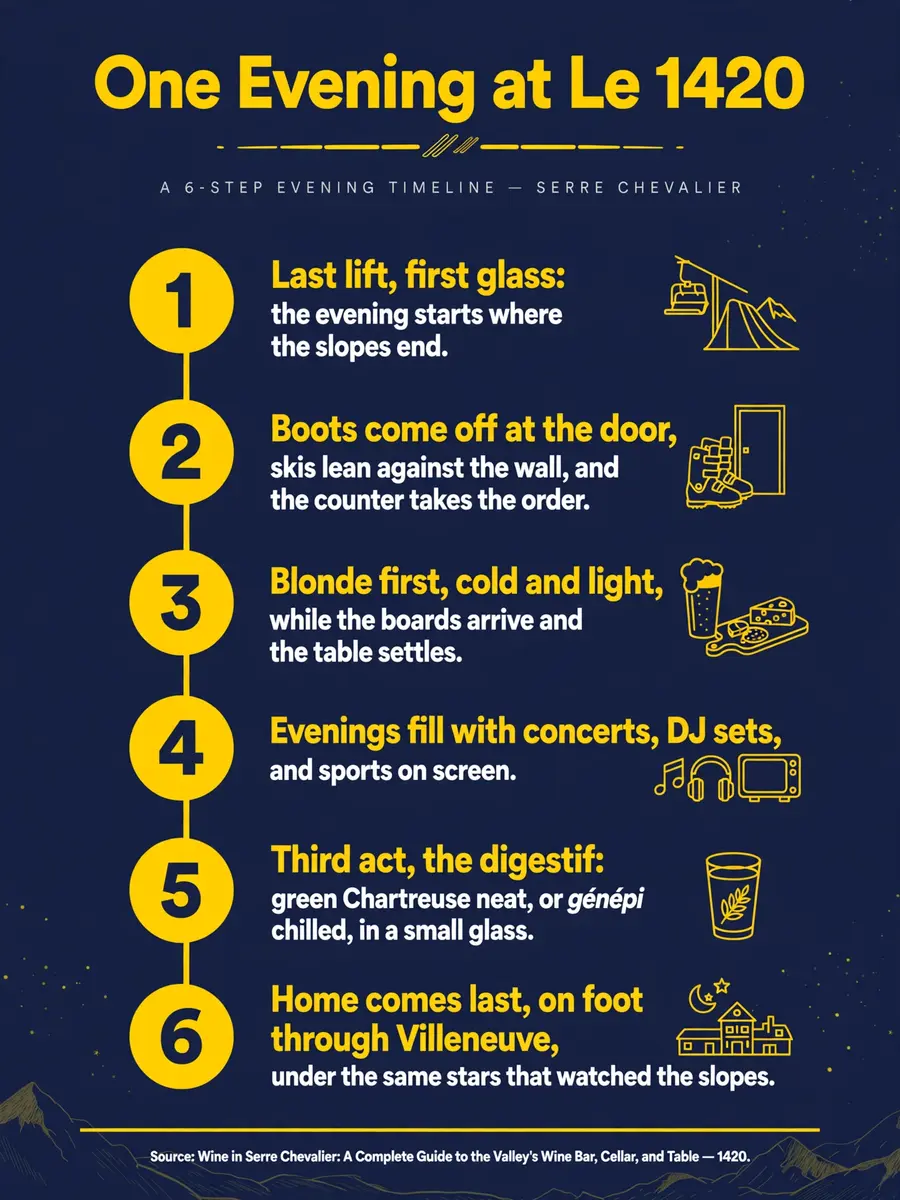
Last lift, first glass: the evening starts where the slopes end.
Boots come off at the door, skis lean against the wall, and the counter takes the order.
Blonde first, cold and light, while the boards arrive and the table settles.
Evenings fill with concerts, DJ sets, and sports on screen, and the Blonde keeps pace with all of them (Serre Chevalier tourist office, 2026).
After skiing, Tourmente takes over the bar: the evenings run on it.
Tourmente alone among the beers belongs to the valley this way.
Here, après-ski means beer, not wine, with the Blonde leading the pour.
Third act, the digestif: green Chartreuse neat, or génépi chilled, in a small glass.
Collectors keep V.E.P. for the glass, not the shaker, and the evening is the wrong time to learn that lesson.
Home comes last, on foot through Villeneuve, under the same stars that watched the slopes.
Walking home is part of the evening, and the guide counts it as such.
Winter evenings run longest, when the lifts close early and the dark comes down at five.
Summer evenings run differently: the bar pours for walkers and cyclists, and the terrace does the work.
What This Guide Does Not Promise
Honesty first: this guide was written from documents, not from a stool at the counter.
Archived catalogue alone gives the prices, years attached; no current price appears anywhere.
Closed in 2023, the shop left its prices in 2021–2023, not today.
The 2014 carte carries no prices at all, and this guide does not supply them.
On the carte three regions survive only as names, and their producers stay unnamed here.
With the season the bar’s current list changes, and the counter knows it better than any guide.
Ask the counter what is pouring today, because the list changes with the season.
Opening hours change with the season too, and the bar posts them at the door.
This guide cannot confirm what the bar pours on a given night, and it does not try.
That shape is the story, and the story survives every season.
Frequently Asked Questions
Where is Le 1420 wine bar?
Foot of the slopes, in Villeneuve, La Salle-les-Alpes, at 1,420 metres (Serre Chevalier tourist office, 2026).
Its name is its altitude, and its village is the liveliest of the four for après-ski.
What is on the 2014 wine carte?
French wine regions number eleven, with named producers, plus three foreign bottles (1420 carte, 2014).
Names and producers fill the archived capture; prices do not appear in it.
Which local drinks does the valley make?
Tourmente beer from Briançon, génépi and liqueurs from the 4 Frères distillery, and one local wine, Domaine Petit Août.
Further north stands its monastery, and the bar keeps ten bottles of it.
How many bottles did the old shop stock?
Fifty-four bottles across eight categories, in the catalogue of 2021–2023 (1420 shop catalogue, 2021–2023).
Chartreuse, champagne, and gin tie at ten bottles each.
What should I order first?
Draught Blonde if it is pouring, green Chartreuse neat as a digestif, or génépi chilled at the end of a meal.
Order by name, not by colour, and ask the counter what is pouring today.
Methodology
Two archives supply the facts here: the 1420 shop catalogue (2021–2023) and the 1420 carte (2014).
INAO, the Serre Chevalier tourist office, and the reference works below supplied the rest, checked on 24 November 2026.
Carte names and producers appear exactly as printed; three regions survive only as names, with no producer invented for them.
Only the archived catalogue supplies prices, and each carries its year; no current price appears anywhere in this guide.
This article bought or tasted no bottle, and it recommends no purchase.
Facts were checked by hand, every one, against the sources in References.
References
- Serre Chevalier in Numbers 2026: 250 Kilometres, 82 Runs, and France’s Best Winter Since 2014/15
- The Serre Chevalier Ski Area: 250 km of Trails
- Serre Chevalier
- Domaines Skiables de France
- Olympics Unveil Alpes 2030 Venue Masterplan
- Appellation d’origine protégée / contrôlée (AOP / AOC)
- Key data on SIQO (INAO)
- Appellation d’origine contrôlée
- Chartreuse Diffusion
- Chartreuse (liqueur)
- Brasserie Tourmente
- Beer, Génépy, and Wine: Taste These Authentic Alpine Drinks
- Genepì delle Alpi GI
- La Marmote | Distillerie des 4 frères
- Savour the taste of the Southern French Alpes terroir
- Skiing in Serre Chevalier (Erna Low)